

What if the most significant threat to your organisation's compliance isn't the physical location of your servers, but the lack of accountability in your administrative layer? Many Danish executives find themselves trapped between the need for scalable cloud innovation and the mounting pressure of data sovereignty concerns with cloud services. It’s a common frustration to feel that your data has become a "black box" where visibility into access and jurisdictional control is lost to the complexities of global providers.
This guide offers a disciplined governance framework for 2026 to resolve these challenges whilst maintaining operational efficiency. You will learn how to master multi-jurisdictional requirements through a model that prioritises transparency and peace of mind. We will examine how ZANGAARD’s Managed IT Operations and IT Infrastructure Management provide the local oversight necessary to transform global cloud assets from a liability into a controlled, high-performance asset for your business.
Key Takeaways
- Understand the critical distinction between where data resides and who governs its access to effectively address data sovereignty concerns with cloud services.
- Identify the "Governance Gap" in your current operations and implement a centralised command centre to regain 24/7 visibility over global data interactions.
- Discover how Managed Dual Shoring bridges the trust gap by combining Danish management standards with offshore technical execution for secure, scalable results.
- Establish a future-proof governance model for 2026 that utilises ZANGAARD’s Managed IT Operations to maintain local accountability over international cloud infrastructure.
Understanding Data Sovereignty Concerns with Cloud Services in 2026
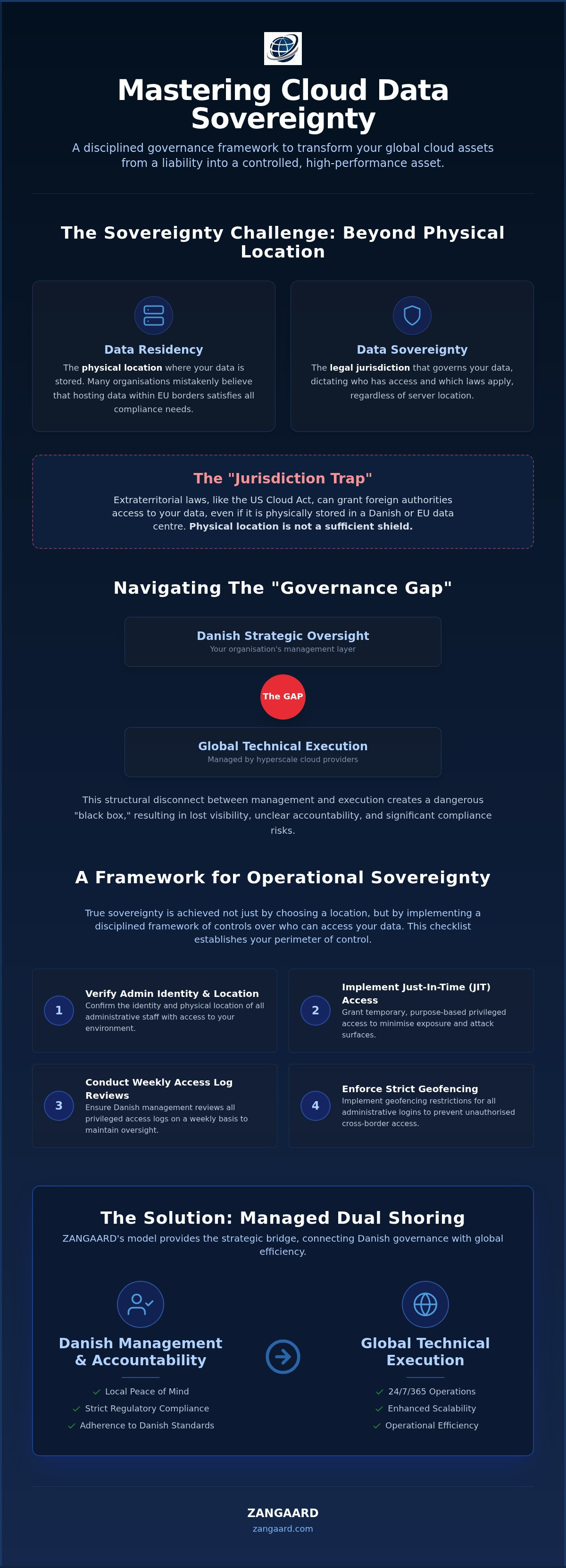
In 2026, data sovereignty is defined by the intersection of physical location, legal jurisdiction, and operational access. Whilst data residency refers simply to where bits are stored, data sovereignty dictates who governs those bits and which laws apply to them. Many Danish organisations mistakenly believe that hosting data within EU borders satisfies all compliance needs. However, data sovereignty concerns with cloud services often stem from the "Jurisdiction Trap," where the legal reach of a cloud provider’s home country supersedes the physical location of the server. This tension has forced a shift toward digital sovereignty, where businesses seek to regain control from global hyperscalers by establishing clearer boundaries of accountability.
The Jurisdiction Trap: Why Physical Location is Only Half the Battle
Physical residency isn't a sufficient shield against extraterritorial laws. If a US-based hyperscaler manages your data in a Danish data centre, foreign authorities may still claim access under specific legal frameworks like the Cloud Act. The 2026 regulatory landscape, shaped by the EU Data Act and updated GDPR requirements, demands a more rigorous approach to cloud procurement. Organisations are now moving towards models that decouple technical execution from legal oversight to mitigate these risks. Operational Sovereignty is the next frontier of data protection, defined as the ability to maintain exclusive authority over who accesses and processes your information. Through ZANGAARD’s Managed IT Operations, we provide this essential layer of Danish oversight, ensuring that your global infrastructure remains under your jurisdictional control without sacrificing performance.
Navigating the Governance Gap in Global Cloud Operations
The "Governance Gap" represents the structural disconnect between technical execution and strategic management oversight. Many organisations fall into the trap of believing that hyperscale cloud providers are solely responsible for sovereignty. In reality, the provider manages the underlying infrastructure, but you remain legally and operationally accountable for the data. To address data sovereignty concerns with cloud services, you must bridge this gap with active supervision. A 24/7/365 Command Centre setup ensures total visibility, transforming your cloud environment from a "black box" into a transparent operational asset. This oversight must be supported by a culture of Continual Improvement to ensure security protocols remain robust against emerging jurisdictional threats.
In specialised fields such as Geographic Information Systems, where data precision and jurisdictional control are paramount, you can check out Formation SIG to provide your team with the necessary professional training to handle complex spatial data assets securely.
Operational Sovereignty: Scrutinising Access and Accountability
True sovereignty requires a Zero Trust approach to administrative access. It’s not enough to know where the data sits; you must know exactly whose "hands are on the keyboard" at any given moment. Effective IT Infrastructure Management serves as the disciplined perimeter that enforces these boundaries. When auditing offshore environments, consider this essential checklist for maintaining control:
- Verification of identity and physical location for all administrative staff.
- Implementation of just-in-time access protocols to limit exposure.
- Weekly reviews of privileged access logs by Danish management.
- Strict geofencing restrictions for all administrative logins.
By establishing these rigorous controls, you shift the burden of risk back into a manageable framework. If you're ready to secure your operational layer and regain peace of mind, you can speak with our consultants about implementing a sovereign oversight model tailored to your needs.
The Managed Dual Shoring Solution: Bridging Efficiency and Sovereignty
Many organisations rely on encryption to mitigate data sovereignty concerns with cloud services, yet technology alone cannot replace human accountability. Managed Dual Shoring acts as the strategic bridge that connects high-level Danish governance with global technical execution. By implementing this model, you ensure that whilst the work may be performed internationally, the responsibility remains firmly rooted in Denmark. This approach eliminates the "black box" effect often found in traditional offshoring, replacing uncertainty with a disciplined framework of oversight and transparency.
Danish Management: Your Safeguard for Global Execution
Local leadership is the only reliable method to secure peace of mind in a multi-shore environment. At ZANGAARD, our Managed Dual Shoring model specifically addresses the complexities of sovereign data governance by placing Danish managers at the helm of our Philippines-based technical teams. This structure ensures that every operational decision adheres to Danish standards of quality and regulatory compliance. It transforms Managed IT Operations into a tool for strategic reassurance, where your infrastructure is managed with the same rigour you would expect from an in-house team.
This synergy allows you to scale without sacrificing security or jurisdictional control. We invite you to contact ZANGAARD for a strategic consultation to discuss how we can refine your cloud operating model for 2026. By choosing a partner that prioritises accountability, you regain the stability needed to focus on your core business objectives.
Securing Your Digital Border for 2026
Mastering data sovereignty concerns with cloud services requires shifting from passive residency to active, disciplined governance. We've explored how the physical location of data is merely the first layer of a complex legal landscape. True control is regained by closing the governance gap through local accountability and rigorous oversight. By adopting Danish Managed IT Standards and a 24/7/365 Command Centre setup, your organisation ensures that every administrative action remains under your jurisdictional authority. Our specialised Managed Dual Shoring model provides the essential bridge between global efficiency and the strategic reassurance of local management. It's time to transform your cloud operations into a resilient, sovereign asset that supports long-term growth whilst maintaining total compliance.
Taking this step ensures your business remains secure and accountable in an increasingly complex global market. Similarly, ensuring you have the right support in complex personal matters—such as arranging home care for the elderly through Het Zorgkabinet—is key to maintaining stability in all areas of life.
Frequently Asked Questions
What is the difference between data sovereignty and data residency?
Data residency refers specifically to the physical location where your information is stored. Data sovereignty is a broader concept that encompasses the legal jurisdiction and operational control governing that data. Whilst residency ensures your bits are in a Copenhagen data centre, sovereignty dictates that Danish or EU laws apply exclusively, preventing foreign authorities from claiming access through extraterritorial legal frameworks.
Can US-based cloud providers truly offer data sovereignty in Europe?
US-based providers often struggle to provide absolute sovereignty due to laws like the CLOUD Act, which allow US authorities to request data regardless of physical server location. To mitigate data sovereignty concerns with cloud services, organisations must implement an additional layer of Danish oversight. This ensures that operational access is governed by local standards even when using global hyperscale infrastructure.
How does Managed Dual Shoring improve data security in the cloud?
Managed Dual Shoring improves security by placing technical execution under the direct oversight of Danish managers. This model eliminates the "black box" of traditional offshoring by ensuring that all administrative actions follow strict Managed IT Operations protocols. It provides a disciplined perimeter where global talent is utilised without compromising the integrity or jurisdictional control of your cloud environment.
What are the main risks of ignoring data sovereignty in 2026?
The primary risks include severe legal liability under the 2026 EU Data Act and updated GDPR mandates. Failing to address data sovereignty concerns with cloud services can lead to significant regulatory fines and irreparable reputational damage. Without a clear governance framework, your organisation remains vulnerable to the "Jurisdiction Trap," where foreign laws may supersede your local data protection efforts.
How can I maintain local accountability whilst using offshore technical teams?
Maintaining local accountability is achieved by decoupling technical work from management oversight. By utilising ZANGAARD’s Managed Dual Shoring model, you benefit from Philippines-based technical execution whilst a Danish management team holds the legal and operational responsibility. This structure ensures that your internal standards are enforced 24/7 through a centralised command centre, providing total visibility into every administrative interaction.
Disclaimer
The purpose of this article is to generate inspiration, reflection and to start a debate across markets, industries and organizations. We do not recommend any actions soly based on the article statements, claims or opinions, but recommend you to reach out directly to ZANGAARD for a qualified review, dialogue and/or consultation. Reach out at [email protected] or visit our website www.zangaard.com


