

What if the incident your team restored last week is already back in the queue? Restoring service quickly matters, but repeated workarounds can leave the underlying cause untouched. Effective it problem management services turn recurring incident patterns into structured investigation and improvement, rather than allowing the same disruption to become routine.
This article explains how problem management differs from incident management and how teams can move from incident records to root-cause action, clear ownership and follow-through. It also looks at how operational support can help keep investigations moving when daily incident pressure takes priority. ZANGAARD’s Managed Dual Shoring combines Danish supervision with Filipino execution to support transparent, accountable IT operations. Explore this approach and the wider ZANGAARD Services portfolio, including Managed Dual Shoring, Consulting and Digital Solutions.
Key Takeaways
- Use it problem management services to move beyond restoring service: investigate the causes behind repeat incidents and manage follow-up as improvement work.
- Build a practical investigation path: spot recurring patterns, record evidence, assess service impact and test possible causes.
- Prioritise investigations by recurrence, impact and available evidence, then assign clear ownership for next steps.
- When operational capacity or accountability is a constraint, explore how ZANGAARD’s Services portfolio connects managed operations with continual improvement and consulting.
What IT problem management services do, and why recurring incidents need a different response
Repeated disruption drains more than technical capacity. Each recurrence can interrupt work, send teams back through familiar recovery steps and leave users uncertain about when service will stabilise. IT problem management services address the cause behind that pattern: they investigate why incidents happen and organise follow-up to reduce the likelihood of the same failure returning.
A problem may be the known or potential cause of one or more incidents. Investigation draws on incident records, technical evidence and operational context to distinguish a shared cause from unrelated events. Teams can use established root-cause analysis techniques to test explanations rather than relying on assumptions. Start by comparing what failed, when it happened, which services or users were affected and what recovery action was taken.
How problem management differs from incident management
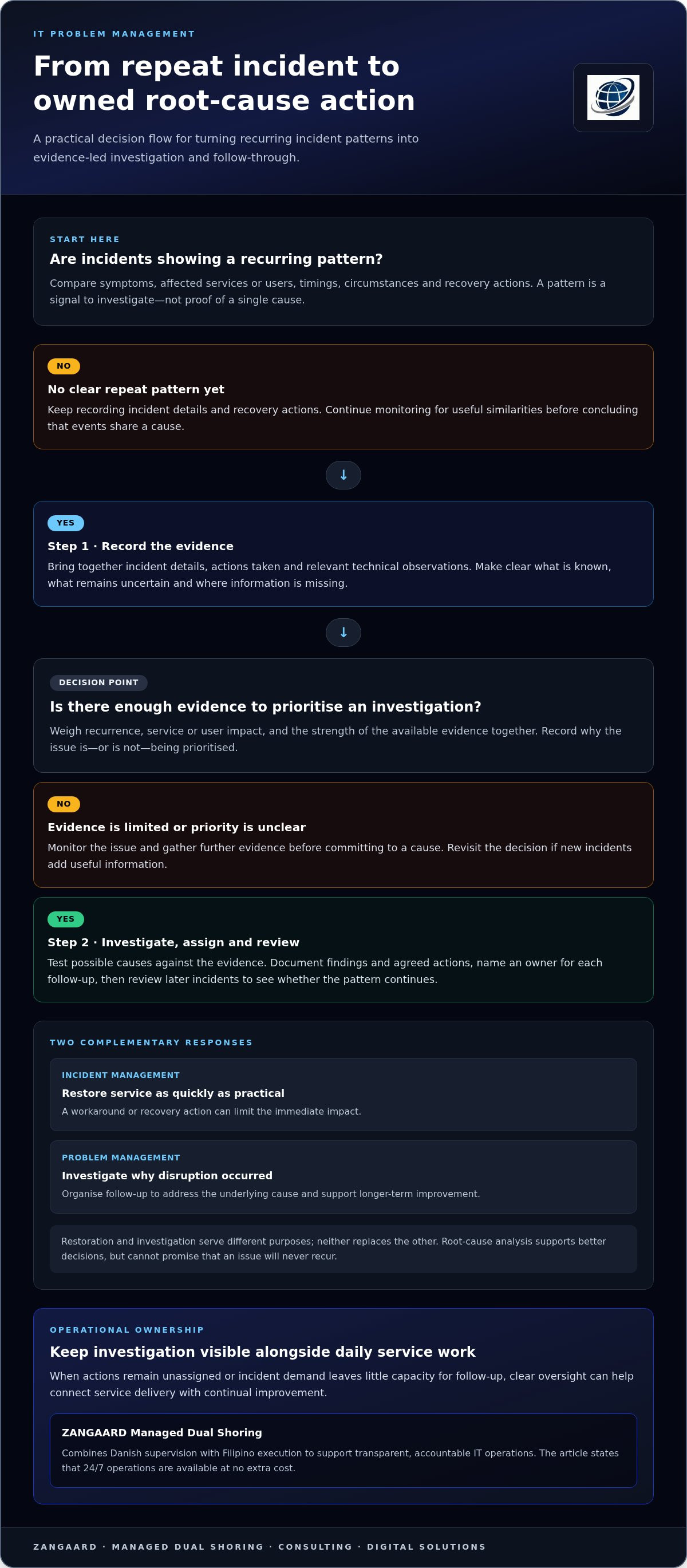
Incident management focuses on restoring service as quickly as practical, often through a workaround or recovery action. Problem management asks why the disruption occurred and what should change to address its underlying cause. The practices complement one another: restoration limits immediate impact, while investigation supports longer-term improvement. Neither replaces the other. For organisations seeking day-to-day operational support across their office systems, managed IT and print specialists such as bendiximaging.com help resolve immediate user disruptions while keeping track of recurring infrastructure faults.
Generic example: Several employees report that access to the same business application drops during a particular task. The service desk restores access each time, but repeated reports suggest a shared cause worth investigating. Compare timestamps, affected users, symptoms and relevant system changes. These details may help the responsible teams determine whether the incidents are connected. A recurring pattern is a signal to investigate, not proof of a single cause.
That distinction also clarifies accountability. Teams need to know who restores service, who investigates the recurring pattern and who owns each agreed action. ZANGAARD’s Managed Dual Shoring combines Danish supervision with Filipino execution, bringing oversight and operational delivery together. Its managed operations provide transparent, accountable IT operations, with 24/7 operations at no extra cost. This model can help keep recurring issues visible alongside day-to-day service work.
How IT problem management services move from incident patterns to root-cause action
A disciplined lifecycle helps teams move from a collection of tickets to a prioritised investigation. Effective it problem management services make the reasoning visible, so decisions reflect evidence and operational impact rather than whichever incident is most recent.
- Detect recurring patterns. Review incident records for repeated symptoms, affected services, timings or circumstances. A pattern can indicate a shared cause, but needs investigation before conclusions are drawn.
- Record the evidence. Bring together incident details, actions taken and relevant technical observations. Record what is known, what remains uncertain and where information is missing. Consistent records make it easier to compare events and identify gaps.
- Assess impact and priority. Consider how often the issue occurs, which services or users it affects and how strong the available evidence is. Weigh these factors together and document why the investigation is being prioritised.
- Investigate, assign and review. Test possible causes, document findings and agreed actions, and name an owner for each follow-up. Review later incidents to see whether the pattern continues or the assessment needs revisiting.
This sequence keeps investigation proportionate. A frequently recurring issue with broad service impact may warrant attention ahead of a rare, contained incident, whilst limited evidence may call for further monitoring before committing to a cause. Record the decision and its rationale, then revisit it if new incidents add useful evidence.
What does root-cause analysis contribute?
Comparing records helps separate visible symptoms from a possible shared cause. For instance, similar failures reported by different users may point to a common dependency, but investigators should test that explanation against the evidence. Findings should lead to specific follow-up, with an owner and review point made clear. Root-cause analysis supports better decisions; it cannot promise that an issue will never recur.
Governance matters as much as diagnosis. ZANGAARD’s service portfolio connects managed IT operations with Consulting and Digital Solutions, supporting organisations that want clearer oversight and follow-through around operational issues.
When IT problem management services need managed oversight and continual improvement
Managed support may be worth considering when the same issues keep returning, investigation ownership is unclear or daily incident demand leaves little capacity for follow-up. For organisations looking to relieve daily operational pressures through dedicated infrastructure assistance, managed IT providers like manage-point.com deliver external operational support to keep core systems running smoothly. If findings regularly stall before anyone can progress them, the challenge may be less about diagnosis and more about making improvement work part of operational governance.
Look for practical signs that the process needs attention: recurring tickets have no linked investigation, actions remain unassigned, or teams cannot explain why one issue takes priority over another. Clear ownership, recorded decisions and regular review give investigations a path forward. ZANGAARD’s Managed Dual Shoring combines Danish supervision with Filipino execution, providing transparent, accountable operations for businesses that need scalable IT support.
How managed dual shoring connects oversight with IT operations
A managed operating model can give teams a defined structure for linking day-to-day service delivery with oversight. ZANGAARD’s Managed Dual Shoring provides 24/7 IT operations at no extra cost, combining Danish supervision with Filipino execution. This can help organisations maintain operational continuity while keeping recurring issues and their follow-up visible.
Explore how these capabilities fit together in the ZANGAARD Services portfolio, particularly if your organisation needs stronger governance around recurring operational issues.
If recurring issues keep competing with planned improvement work, discuss your IT operations with ZANGAARD and consider a more structured path for moving follow-up forward.
Make the next recurring ticket a turning point
Choose one recurring issue and make its next step explicit: what needs to be understood, who will own the follow-up and when the outcome will be reviewed. This focused commitment can help show whether your approach to it problem management services is turning investigation into accountable improvement, rather than adding another unresolved record to the queue.
Then consider what would make that discipline consistent across your IT operations. ZANGAARD’s Managed Dual Shoring combines Danish supervision with Filipino execution, supporting transparent, accountable IT operations and 24/7 service at no extra cost. The ZANGAARD Services portfolio brings together Managed Dual Shoring, Consulting and Digital Solutions.
A more deliberate response to recurring issues starts with one well-owned next step. Build from there with clearer oversight and a practical route from investigation to improvement.

Disclaimer
The purpose of this article is to generate inspiration, reflection and to start a debate across markets, industries and organizations. We do not recommend any actions soly based on the article statements, claims or opinions, but recommend you to reach out directly to ZANGAARD for a qualified review, dialogue and/or consultation. Reach out at [email protected] or visit our website www.zangaard.com


