

What if your digital transformation is being throttled by the very architecture meant to support it? Many Danish enterprises find that legacy IT structures act as a handbrake on agility, especially whilst domestic talent costs continue to climb. You likely recognise the frustration of seeking innovation only to be met with the opacity of traditional offshore models. This guide demonstrates how to modernise your IT operating model for digital transformation, moving from reactive maintenance to a disciplined, digital-first strategy. We will explore how to integrate global technical talent with the strategic reassurance of local Danish accountability. You'll discover a clear roadmap to reduce operational overheads and establish a governed, scalable infrastructure that supports growth through 2026. This methodology is central to the ZANGAARD service portfolio, where we bridge high-level strategy with grounded operational reliability.
Key Takeaways
- Define the critical distinction between basic digitisation and a comprehensive digital-first strategy that prioritises organisational agility and value creation.
- Identify how a modernised IT operating model for digital transformation bridges the gap between high-level strategy and grounded, daily operational execution.
- Recognise the necessity of industrialising technical execution through specialised IT infrastructure management to free internal leadership for core strategic initiatives.
- Gain insights into the Managed Dual Shoring model, which provides a secure path to global scalability without sacrificing the transparency of Danish governance.
Defining the Digital First Business Strategy for 2026
A digital-first strategy is a fundamental shift in mindset where digital capabilities act as the primary driver of value creation. It's about placing digital logic at the heart of every business process. Whilst many organisations confuse this with simple digitisation, converting analogue data into digital formats is merely a precursor. True Digital transformation requires a robust IT operating model for digital transformation that prioritises agility over traditional, static hierarchies.
Danish enterprises must evolve now to avoid the "legacy trap." These rigid, traditional IT structures cannot scale and often become a financial burden. In a market where technical talent costs are amongst the highest in Europe, maintaining legacy systems internally is increasingly unsustainable. Adopting managed IT operations provides the necessary catalyst for this change. It allows businesses to industrialise their technical execution, ensuring that operational overheads are controlled whilst performance remains high.
The Shift from Legacy Thinking to Strategic Digital Governance
Transitioning to a digital-first model means moving away from reactive, ad-hoc IT support. Instead, it involves implementing a proactive digital transformation strategy. This shift ensures that every technical decision aligns with local Danish business objectives. A robust technology roadmap provides the necessary oversight for a modern IT operating model for digital transformation, ensuring global technical execution remains transparent and accountable. This structured governance is a core component of the ZANGAARD service portfolio, where we bridge the gap between high-level ambition and daily operational reliability. By shifting the burden of management to a disciplined partner, leaders regain the peace of mind needed to drive growth.
Building the Operational Backbone for Scalable Growth
To sustain a digital-first initiative, an organisation must move beyond ad-hoc technical fixes. A successful Digital-First Strategy relies on an industrialised IT operating model for digital transformation. This backbone is supported by robust IT infrastructure management services. By standardising these core functions, internal leadership can pivot from daily firefighting to high-level strategy. This transition is essential for Danish firms where technical talent costs often exceed 800,000 kr. per annum for senior roles. Decoupling growth from rising domestic overheads ensures that expansion doesn't erode margins.
Global business continuity in 2026 requires a 24/7 IT service desk. This isn't merely about basic availability; it's about maintaining a seamless operational flow across all time zones. When technical execution is industrialised through specialised partners, the business gains the elasticity to scale rapidly without the risk of over-hiring locally. This structured approach provides the transparency and governance required to manage complex, distributed environments.
Industrialising IT Operations for Modern Efficiency
ZANGAARD provides a bridge between strategic ambition and reliable execution. Our Managed IT Operations integrate disciplined Danish management with high-tier technical execution. This hybrid approach ensures that whilst the "heavy lifting" happens globally, accountability remains local. We focus on "Continual Improvement" as a core discipline to drive long-term digital maturity. This rigorous process identifies bottlenecks before they impact the bottom line, providing the strategic reassurance leaders need to focus on innovation. If you're ready to stabilise your infrastructure, you can contact ZANGAARD to discuss industrialising your operational backbone through a modernised IT operating model for digital transformation.
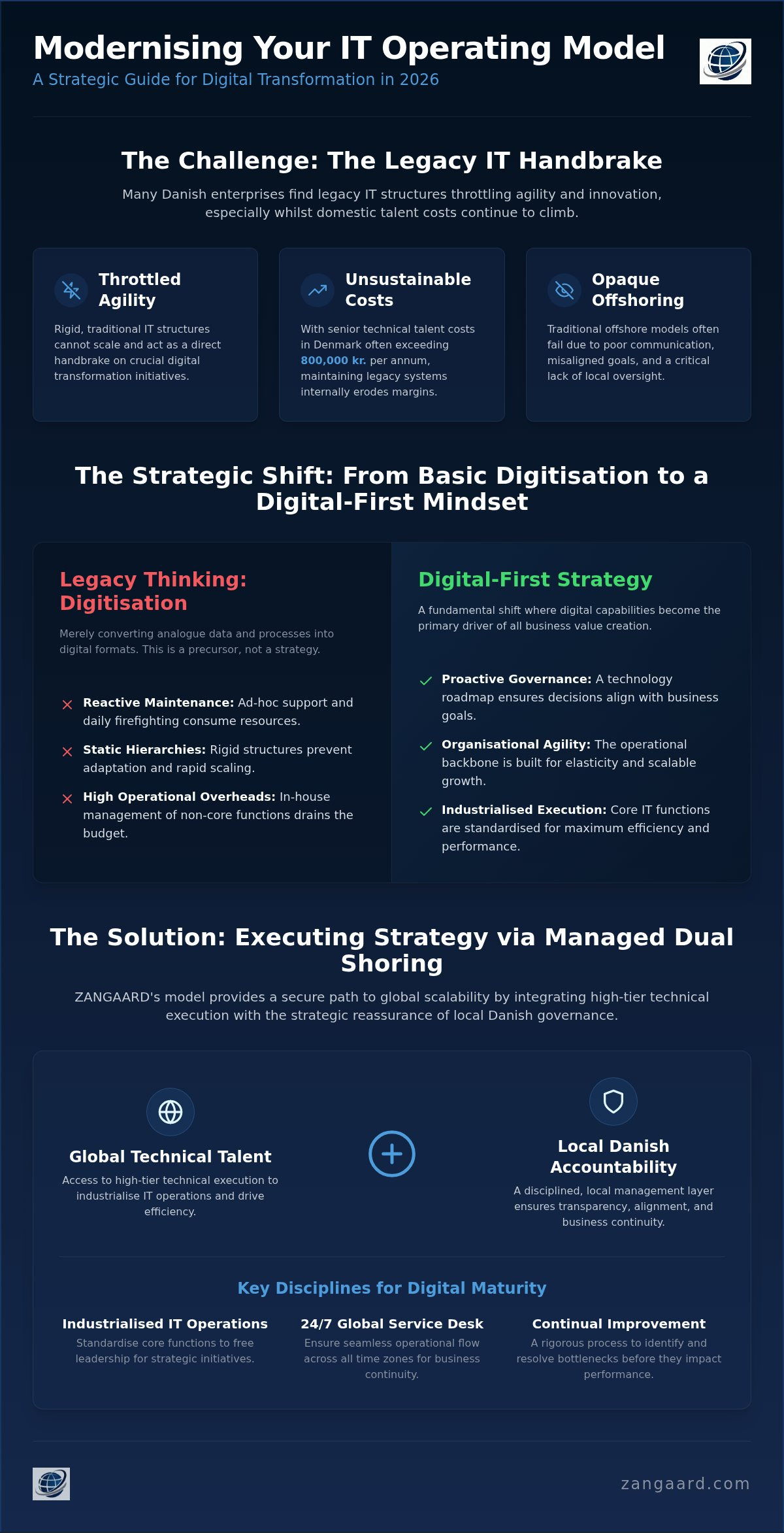
Executing Digital Strategy via Managed Dual Shoring
Traditional offshoring models often collapse under the weight of poor communication and misaligned incentives. Managed Dual Shoring serves as the ultimate vehicle for executing a digital-first strategy whilst mitigating these risks. By contrast, single-country offshoring lacks the essential layer of local Danish oversight that protects business continuity. This hybrid model represents the logical conclusion for any firm pursuing a modern IT operating model for digital transformation in 2026. It combines the scalability of global technical teams with the disciplined governance of Nordic leadership standards.
The Philippines represents an ideal technical talent pool, yet its success depends on cultural alignment and rigorous process frameworks. When managed under Danish standards, these teams deliver the high-quality output required for complex digital initiatives. This setup allows you to scale your operations without the friction typically associated with international expansion. It provides a structured path to efficiency that legacy IT structures simply cannot match.
Bridging the Gap Between Cost-Efficiency and Local Accountability
ZANGAARD facilitates IT outsourcing in the Philippines by applying a unique Danish management layer to every operation. This "Managed" aspect ensures that whilst execution occurs globally, accountability remains firmly local. You don't have to navigate foreign regulations or cultural nuances alone. Instead, you gain a partner who acts as a bridge-builder, connecting high-level strategy with daily technical reliability. This approach transforms the IT operating model for digital transformation from a risky experiment into a controlled, industrialised process. We invite you to explore the full ZANGAARD service portfolio to see how these principles drive operational excellence and provide peace of mind for our clients.
Securing Your Operational Future in 2026
Transitioning to a digital-first strategy is no longer optional for Danish enterprises seeking to remain competitive. It requires a fundamental shift from legacy thinking to a modernised IT operating model for digital transformation. By industrialising your technical execution and leveraging scalable global IT infrastructure, you regain the capacity to focus on core business objectives. ZANGAARD provides the strategic reassurance of Danish-led management standards combined with 24/7/365 Command Centre capabilities. This ensures that whilst your operations scale globally, your accountability remains local and transparent. We handle the complexities of international delivery so you can enjoy the peace of mind that comes with disciplined governance and unwavering reliability.
It's time to reclaim control of your technology roadmap and build a foundation for sustainable growth. Take the first step toward a more resilient and agile future today.
Frequently Asked Questions
What is the primary difference between a digital-first and a traditional business strategy?
Traditional strategies treat IT as a reactive support function designed to maintain existing systems. A digital-first strategy reverses this logic, making digital capabilities the primary engine of value creation. It's a fundamental mindset shift where every business process is designed with digital scalability in mind first. This ensures the organisation remains agile and capable of pivoting as market conditions evolve through 2026. Part of this agility involves implementing specialised business tools; for example, Apollonix Tecnologia helps firms integrate and automate their software ecosystems to drive better operational performance.
Can small to medium-sized enterprises implement a digital-first strategy effectively?
SMEs can implement this strategy effectively by leveraging external expertise rather than building large internal departments. Utilising the ZANGAARD service portfolio allows smaller firms to access enterprise-grade infrastructure and global talent pools. This approach levels the playing field, allowing SMEs to compete with larger organisations whilst maintaining strict control over their operational overheads and domestic costs in Denmark.
Why is local accountability crucial when using offshore technical teams for digital projects?
Local accountability acts as the bridge connecting global technical execution with Danish business standards. It eliminates the risks of transparency gaps and cultural friction often found in traditional offshoring models. A robust IT operating model for digital transformation requires a partner who takes full responsibility in Denmark. This provides peace of mind, knowing that complex international operations are handled with disciplined oversight.
Disclaimer
The purpose of this article is to generate inspiration, reflection and to start a debate across markets, industries and organizations. We do not recommend any actions soly based on the article statements, claims or opinions, but recommend you to reach out directly to ZANGAARD for a qualified review, dialogue and/or consultation. Reach out at [email protected] or visit our website www.zangaard.com


