

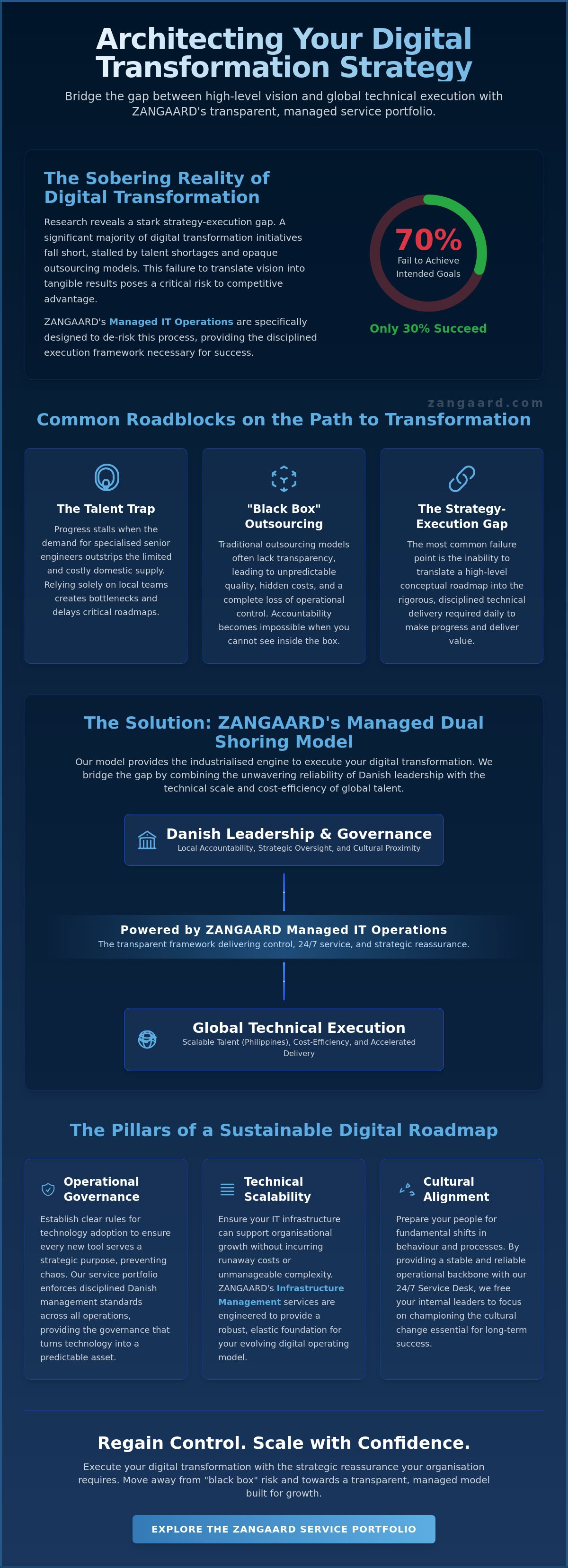
Research indicates that only 30 per cent of digital transformations achieve their intended goals. It is a sobering reality for many executives who find their vision stalled by a lack of domestic expertise or opaque outsourcing models that lack transparency. You likely recognise the frustration of a widening gap between high-level objectives and actual technical delivery. This guide shows you how to architect a digital transformation strategy that bridges this divide by combining disciplined Danish leadership with the technical scalability of global operations.
By leveraging the ZANGAARD Services portfolio, you can move away from "black box" risks and towards a transparent, managed model. We will explore a clear roadmap for digital maturity and demonstrate how our service offerings, such as managed IT operations and infrastructure management, provide the steady hand needed for global execution. You will discover how to regain control whilst ensuring your international teams are managed to rigorous local standards, providing the strategic reassurance your organisation requires.
Key Takeaways
- Distinguish between simple digitisation and true transformation to ensure your digital operating model is fundamentally reimagined for future scalability.
- Identify the core reasons for the strategy-execution gap and learn how to align high-level vision with rigorous, daily technical delivery.
- Architect a digital transformation strategy that bypasses domestic talent shortages by integrating the technical scale of global operations.
- Discover how ZANGAARD Services utilise a Managed Dual Shoring model to provide Danish governance alongside cost-efficient global execution.
- Explore our service portfolio to understand how Managed IT Operations deliver the transparency and stability your organisation requires.
What is a Digital Transformation Strategy in 2026?
A digital transformation strategy is far more than a technical upgrade; it's a formalised architecture for integrating digital technology across every business function to fundamentally change how value is delivered. Whilst many organisations confuse digitisation, the act of converting analogue data to digital formats, with true transformation, the latter requires a complete reimagining of the digital operating model. According to a foundational overview of What is Digital Transformation?, the process involves a cultural change that requires organisations to continually challenge the status quo. In 2026, this evolution must be guided by "Composed Authority," a principle where rapid innovation is balanced by disciplined operational control. It marks the end of project-based IT and the beginning of a continuous, managed evolution.
The Core Components of a Sustainable Digital Roadmap
Successful strategies rest on three pillars that ensure long-term stability. Operational Governance establishes the rules for technology adoption, ensuring every new tool serves a strategic purpose. Technical Scalability ensures your IT Infrastructure Management supports growth without ballooning costs or complexity. Finally, Cultural Alignment prepares your people for shifts in behaviour. With 89 per cent of companies having already adopted a digital-first strategy, the differentiator in 2026 isn't the technology itself, but the governance behind it.
Why Strategic Governance Outweighs Tactical Implementation
Selecting a specific software suite is rarely the deciding factor in success. Instead, the oversight framework determines whether a tool delivers ROI or becomes a "black box" liability. By applying Danish management standards to global technical teams, we ensure that every action aligns with your high-level vision. This disciplined approach is central to our service portfolio, where we bridge the gap between strategy and daily execution. Governance provides the peace of mind that your operations remain stable whilst you scale. It transforms IT from a cost centre into a predictable engine for growth, managed with the transparency business leaders demand.
Overcoming Friction: The Strategy-Execution Gap
Research suggests that the primary reason transformations fail is the inability to translate high-level vision into daily technical execution. This disconnect often stems from the "Talent Trap," where the scarcity of local senior engineers in high-cost markets like Denmark stalls progress. A successful digital transformation strategy requires more than just a conceptual roadmap; it demands "Strategic Reassurance." This is the confidence that comes from knowing execution is handled by a disciplined, steady hand that maintains absolute transparency across multi-location operations. You shouldn't have to choose between high-level oversight and technical scale.
Bridging the Talent Gap with Scalable Technical Teams
Relying solely on domestic teams often limits the speed of change because the demand for specialised skills far outstrips local supply. By accessing a global talent pool, you can accelerate your technology roadmaps whilst maintaining the rigorous standards your organisation expects. Dual Shoring is the strategic integration of local Danish management with offshore technical execution to ensure both cultural proximity and operational scale. This model allows you to scale up resources rapidly without the overhead of domestic recruitment cycles.
Maintaining Accountability Whilst Scaling Globally
Traditional outsourcing often feels like a "black box" where transparency vanishes and quality becomes unpredictable. We eliminate this risk through local oversight and a 24/7 Service Desk that ensures operational availability across all time zones. In a modern digital transformation strategy, accountability is non-negotiable. Our Managed IT Operations provide the framework needed to manage complex global teams to local standards. If you're seeking a partner to bridge the gap between vision and reality, our service portfolio illustrates how we maintain these standards for global enterprises.
Implementing Your Strategy: The ZANGAARD Managed Dual Shoring Model
ZANGAARD’s Managed IT Operations provide the industrialised engine required to execute a digital transformation strategy. This model offers the cost-efficiency of technical talent in the Philippines paired with the unwavering reliability of Danish leadership. It allows firms to expand their footprint without the risk of losing operational control. As McKinsey notes in their analysis of digital transformation strategy, success depends on building specific internal capabilities; we act as that capability partner for you. By serving as a Disciplined Global Architect, we ensure your enterprise technology remains a stable foundation for growth rather than a source of friction.
Integrating Danish Management with Global Technical Execution
Local accountability is the cornerstone of the ZANGAARD Services portfolio. Whilst our technical teams in the Philippines execute the granular details of your technology roadmap, the governance remains rooted in Danish process standards. This synergy creates a disciplined environment where quality is never sacrificed for scale. It ensures that the technical execution of your global operations is matched by a culture of high standards and cultural intelligence. You gain the benefit of global reach without the typical communication or quality barriers found in traditional outsourcing.
The ZANGAARD Approach to Long-term Digital Stability
We guide organisations from a state of operational complexity to a state of streamlined simplicity. Through our Digital Transformation Consulting, we ensure your strategy remains tightly aligned with your business goals over the long term. The result is the promise of "Control Regained" through professional oversight. By exploring our service portfolio, you can see how we maintain stability and 24/7 availability for our clients. This managed approach shifts the burden of technical management from your shoulders to ours, providing the strategic reassurance necessary to lead your organisation forward with confidence.
Mastering Your Digital Future with Composed Authority
A successful digital transformation strategy requires a disciplined move away from fragmented IT projects towards a continuous, managed evolution. You've seen how the gap between vision and execution often stems from a lack of high-level oversight and the domestic talent trap. By architecting a model that balances Danish management standards with global technical scale, you regain control over your operational destiny. It's about shifting the burden of management to a steady hand so you can focus on high-level objectives.
Our specialised Managed Dual Shoring model provides the transparency and accountability essential for modern enterprise growth. We invite you to Explore ZANGAARD’s Managed IT Operations and Service Portfolio to see how we deliver peace of mind through rigorous governance. Reviewing our service portfolio and broader ZANGAARD Services reveals a structured methodology designed for stability and 24/7 availability. We're ready to act as your Disciplined Global Architect, ensuring your technology infrastructure supports your ambitions without compromise. The path to digital maturity is within reach when you have the right partner at your side.
Frequently Asked Questions
What are the first steps in creating a digital transformation strategy?
The first steps involve a rigorous audit of your current digital maturity and a clear definition of your desired business outcomes. You need to establish a governance framework before selecting any specific technology to ensure every investment serves a strategic purpose. Our Digital Transformation Consulting helps you identify these priorities to ensure your roadmap is both realistic and impactful. It's about building a foundation that supports long-term evolution rather than just short-term technical fixes.
How does the Dual Shoring model improve digital transformation outcomes?
Dual Shoring improves outcomes by bridging the gap between high-level strategy and technical execution. It solves the local talent shortage by providing access to a scalable pool of experts in the Philippines whilst maintaining Danish oversight. This model, central to ZANGAARD Services, ensures that your digital transformation strategy is executed with both cost-efficiency and local accountability. You get the speed of global scale without sacrificing quality or transparency.
What is the difference between digital transformation and IT modernisation?
IT modernisation focuses on upgrading specific technical assets like servers or cloud environments, whereas digital transformation reimagines the entire operating model. Modernisation is a tactical necessity, but transformation is a strategic shift in how your business creates value through technology. Our service portfolio demonstrates how we manage both technical infrastructure and the broader strategic evolution. True transformation requires aligning your technology with your fundamental business processes to drive efficiency.
Can a small or medium-sized Danish enterprise afford a full digital transformation strategy?
Yes, SMEs can afford a comprehensive digital transformation strategy by utilising scalable, managed service models that reduce overhead. Managed Dual Shoring allows smaller firms to access the same level of technical expertise and governance as large enterprises without the prohibitive costs of domestic recruitment. By leveraging Managed IT Operations, you can scale your digital capabilities incrementally. It's a pragmatic way to achieve industrialised precision and strategic growth within a controlled budget.
How do I ensure data security whilst using offshore technical teams?
You ensure data security by implementing rigorous governance standards and maintaining local management over global teams. It's vital to choose a partner that applies Danish security protocols and oversight to offshore technical operations. We manage this through ZANGAARD Services, providing the disciplined oversight needed to mitigate operational risks. This approach eliminates the "black box" effect and gives you peace of mind that your data is handled according to strict local regulations.
Why is Danish management important for offshore IT operations?
Danish management is essential because it provides cultural alignment and a commitment to transparency that offshore-only models often lack. It ensures that technical teams understand your business values, quality expectations, and specific operational standards. Our service portfolio highlights how this bridge-building role creates a sense of partnership. You gain a disciplined architect who manages the complexities of global operations whilst remaining directly accountable to you in the domestic market.
Disclaimer
The purpose of this article is to generate inspiration, reflection and to start a debate across markets, industries and organizations. We do not recommend any actions soly based on the article statements, claims or opinions, but recommend you to reach out directly to ZANGAARD for a qualified review, dialogue and/or consultation. Reach out at [email protected] or visit our website www.zangaard.com


