

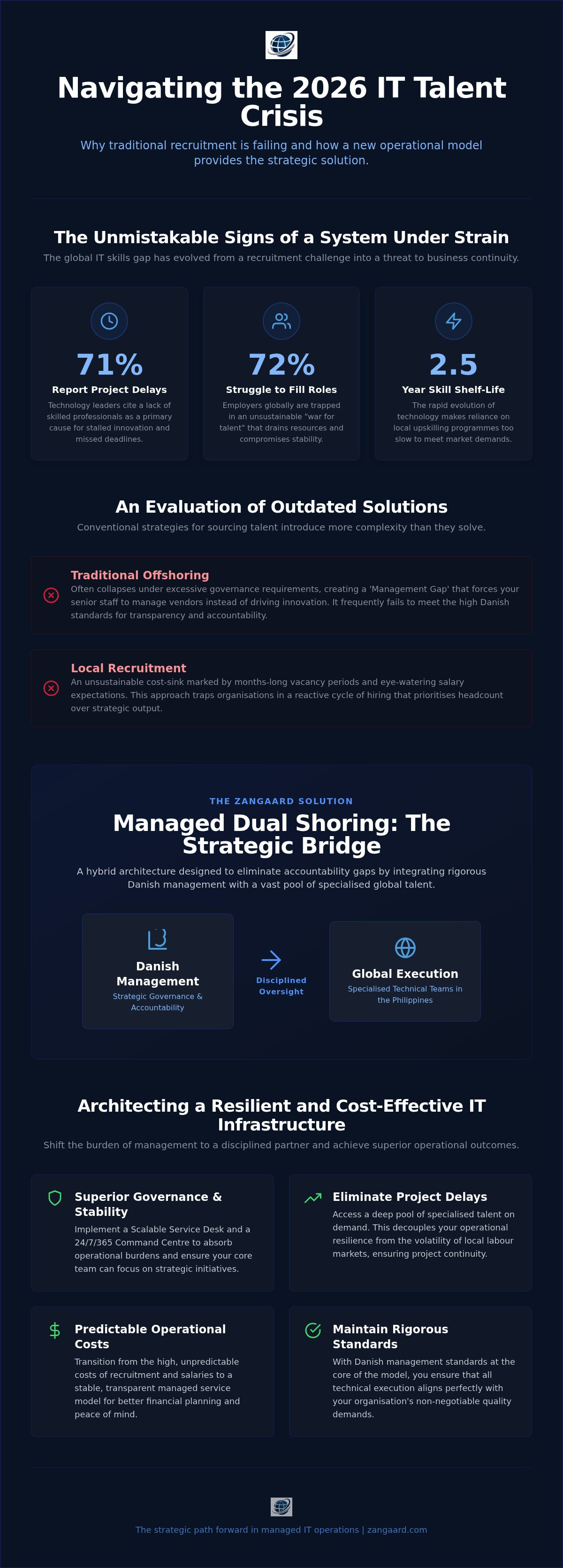
With 71% of technology leaders reporting significant project delays due to a lack of skilled professionals, it's clear that traditional IT talent shortage solutions are failing to meet the demands of 2026. You've likely experienced the exhaustion of months-long vacancy periods and the eye-watering salary expectations that make local recruitment feel like an impossible task.
It's understandable to feel hesitant about looking abroad, especially if you've been burnt by unmanaged vendors who delivered complexity instead of results. This guide promises a different path. It's a strategic way to bypass the recruitment crisis by architecting a hybrid IT operational model that prioritises accountability. We'll examine how Managed Dual Shoring integrates Danish management standards with specialised global execution to create a scalable IT department. By shifting the burden of management to a disciplined partner, you can finally secure predictable operational costs and the peace of mind that your organisation's high-stakes operations are in steady hands.
Key Takeaways
- Understand why the escalating global skills gap requires a shift from traditional hiring to architecting Managed IT Operations as a core pillar of your IT talent shortage solutions.
- Evaluate the strategic benefits of Managed Dual Shoring, ensuring that technical execution in the Philippines remains under the disciplined control of Danish management standards.
- Learn how to eliminate project delays by implementing a Scalable Service Desk and a 24/7/365 Command Centre setup for superior operational governance and stability.
- Discover how to build a resilient and cost-effective IT infrastructure by exploring the professional solutions within the ZANGAARD service portfolio.
The 2026 IT Talent Shortage: Why Traditional Recruitment is Failing
The current IT skills gap has evolved from a recruitment challenge into a fundamental threat to business continuity. With 72% of employers globally struggling to fill open roles, the traditional "war for talent" has become an unsustainable cost-sink for most enterprises. Relying solely on local hiring or slow-moving internal upskilling programmes often fails because specialised technical skills now have a shelf life of roughly 2.5 years. This creates a structural paradox where Technological Unemployment in legacy sectors occurs alongside a desperate, unmet demand for AI and cybersecurity expertise that the local market simply cannot supply.
If your projects are stalling, it's worth asking if your current operational model is the actual bottleneck. Many organisations remain trapped in a cycle of reactive hiring that prioritises headcount over output. Effective IT talent shortage solutions in 2026 require a shift from talent acquisition to strategic capacity management. You can't wait for the local market to correct itself whilst your competitors are already optimising their delivery frameworks through more agile, global structures.
The High Cost of Empty Desks in Managed IT Operations
Vacancies aren't just missing lines on an organisational chart; they represent stalled innovation and mounting pressure on existing staff. This burnout cycle leads to further turnover, creating a self-perpetuating crisis that compromises your long-term stability. By moving towards a model of Strategic Governance, leaders can decouple their operational resilience from the volatility of local labour markets. Exploring the ZANGAARD service portfolio provides a framework for this transition, shifting the burden of management from the client to a disciplined partner. This ensures that infrastructure remains robust and high-stakes operations continue without interruption, regardless of local hiring conditions.
Scaling Beyond Borders: Evaluating IT Talent Shortage Solutions
Evaluating global delivery models requires a disciplined focus on three critical pillars: scalability, cost-efficiency, and management overhead. Whilst nearshoring offers cultural proximity, it often fails to provide the true technical depth required in 2026. Conversely, traditional offshoring provides cost relief but frequently collapses under the weight of excessive governance requirements. Many leaders find that single-country offshoring without local oversight is a high-risk gamble, often resulting in fragmented operations that lack a steady hand.
Why Traditional Offshoring Often Fails Danish Standards
Danish management standards demand a level of transparency and accountability that unmanaged offshore vendors rarely provide. When technical execution is detached from local oversight, a "Management Gap" emerges, forcing your senior staff to spend more time on vendor governance than on strategic innovation. Bridging these two worlds requires a Disciplined Global Architect who can align high-level strategy with daily execution. This ensures that your infrastructure remains robust and your quality standards remain non-negotiable across every time zone.
Implementing a 24/7 IT service desk acts as a primary stabiliser amongst broader IT talent shortage solutions. It offers immediate relief by absorbing the operational burden of daily support, allowing your core team to regain their focus. By integrating these services into a hybrid model like Managed Dual Shoring, you achieve a balance of quality and scalability that traditional models cannot replicate. To see how this architecture fits your specific operational needs, you may wish to speak with our strategic consultants.
Managed Dual Shoring: The Strategic Bridge to Global Talent
Managed Dual Shoring represents the sophisticated evolution of global delivery, specifically designed to eliminate the accountability gaps inherent in traditional models. By integrating local Danish management with technical execution in the Philippines, this hybrid architecture functions as a primary pillar amongst effective IT talent shortage solutions. It allows enterprises to access a vast pool of technical expertise whilst maintaining the rigorous oversight that high-stakes operations require.
At the heart of this model is the concept of Managed IT operations. ZANGAARD organises these complex workflows to ensure that the client's strategic goals are never lost in translation. This systematic approach provides the "peace of mind" that only comes from knowing that Danish standards are being applied to every technical task, regardless of geographical distance. It's about regaining control over your infrastructure through a disciplined, industrialised process.
Combining Danish Leadership with Philippines Scalability
The Philippines offers a unique combination of high English proficiency and strong cultural alignment, making it an ideal hub for technical execution. ZANGAARD’s Managed Dual Shoring (MDS) model leverages these strengths whilst removing the risks associated with unmanaged offshoring. It's a no-nonsense framework where the burden of daily management is shifted from your internal team to our disciplined experts. This ensures that quality remains consistent and scalability becomes a predictable operational reality.
This architecture doesn't just fill empty desks; it builds a resilient operation that scales with your business. We encourage you to explore our full range of services to discover how this disciplined bridge between high-level strategy and daily execution can transform your IT department into a predictable, high-performance asset.
Transforming Operational Resilience through Strategic Governance
The landscape of 2026 demands a departure from reactive hiring. We've explored how traditional recruitment fails to keep pace with technological shifts and why unmanaged offshore models often compromise quality. Managed Dual Shoring provides a disciplined alternative, ensuring that your infrastructure is supported by scalable Philippines technical teams whilst remaining under the strict control of Danish management standards. This hybrid architecture doesn't just fill vacancies; it establishes a robust framework for continual improvement. By integrating a 24/7/365 Command Centre into your workflow, you secure the stability required for high-stakes operations. It's time to move beyond temporary fixes and implement long-term IT talent shortage solutions that guarantee both performance and peace of mind.
Regain control of your technical roadmap and build a department that's ready for the challenges of tomorrow.
Frequently Asked Questions
What is the most effective solution for the IT talent shortage in 2026?
Managed Dual Shoring is the most effective approach because it addresses the governance crisis rather than just the recruitment crisis. By combining Danish management with technical execution in the Philippines, organisations bypass local scarcity whilst ensuring high standards. This architecture, found in the ZANGAARD service portfolio, provides a scalable framework for Managed IT Operations, allowing leaders to focus on strategy instead of empty desks.
How does Managed Dual Shoring differ from traditional IT outsourcing?
Managed Dual Shoring differs from traditional outsourcing by integrating local accountability with global execution. Standard outsourcing often leaves a management gap where the client must govern the vendor's daily tasks. ZANGAARD closes this gap by applying Danish management standards to offshore technical teams. This creates a disciplined bridge between strategy and execution, ensuring that operational reliability isn't lost in translation.
Can an offshore IT team maintain the same quality standards as a local team?
Yes, quality is maintained through a disciplined governance framework that prioritises accountability. By leveraging a Scalable Service Desk and a 24/7/365 Command Centre setup, technical execution remains under constant oversight. This model ensures that Danish quality benchmarks are consistently met whilst accessing the specialised technical expertise available in the Philippines tech talent pool.
How much can a business save by adopting a hybrid IT operational model?
Businesses typically achieve a significant reduction in total cost of ownership by moving away from expensive local recruitment and the hidden costs of project delays. This hybrid model provides predictable operational costs and eliminates the financial burden of local salary wars. It's one of the most sustainable IT talent shortage solutions for maintaining a high-performance infrastructure without compromising on quality or control.
Disclaimer
The purpose of this article is to generate inspiration, reflection and to start a debate across markets, industries and organizations. We do not recommend any actions soly based on the article statements, claims or opinions, but recommend you to reach out directly to ZANGAARD for a qualified review, dialogue and/or consultation. Reach out at [email protected] or visit our website www.zangaard.com


