

Local management can improve coordination and accountability, but it does not remove the need for technical oversight. Offshore IT with local management is cost-effective only when the total effort to deliver and maintain the work is lower, not simply because offshore labour rates are lower. A technical owner still needs to guide decisions and review the work.
It’s reasonable to expect a local point of contact to make day-to-day collaboration easier. The real value depends on how responsibilities are divided, how much working-time overlap the teams have, and whether dedicated offshore employees have clear priorities and support. This article explains how to assess the full cost, organise workday coordination and understand the management structure behind the arrangement, including where technical oversight remains essential.
Key Takeaways
- Assess the full cost of delivery and ongoing maintenance, not just offshore labour rates.
- Plan communication around working-hour overlap, clear handovers and agreed responsibilities.
- Clarify how dedicated offshore employees are managed and supported within the operating model.
- Keep an accountable technical owner in place to guide decisions and review work, even with local management.
Comparing total delivery cost rather than development rates
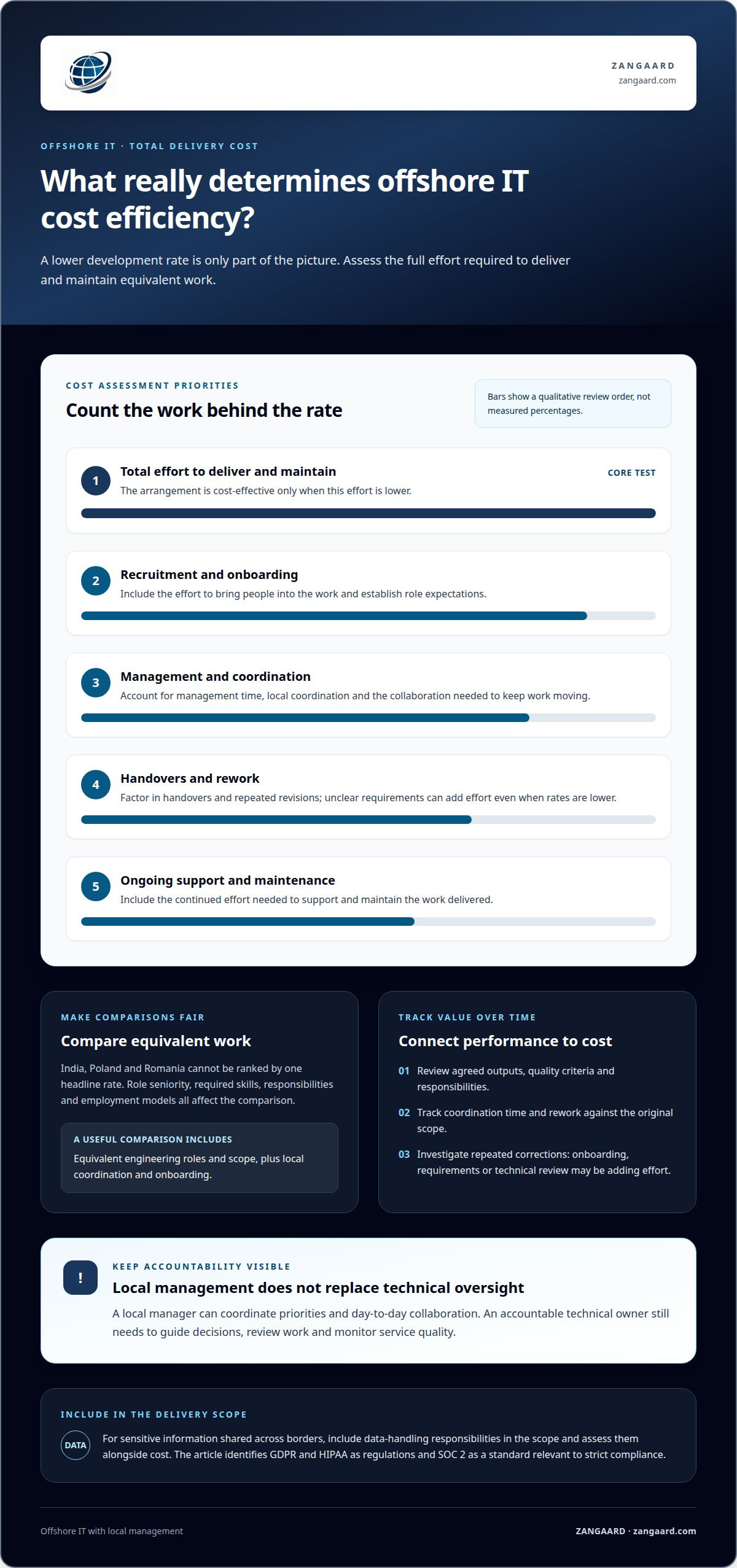
For a Danish business, offshore IT cost efficiency depends on the complete delivery model, not a developer’s rate alone. Include onboarding, management, collaboration and ongoing maintenance when assessing the operational cost.
India, Poland and Romania cannot be ranked by one headline rate. Role seniority, required skills, responsibilities and employment models all affect the comparison. Assess equivalent engineering roles and scope, then account for local coordination and onboarding. This gives a more useful picture of offshore labour savings than comparing rates in isolation.
Total delivery cost efficiency
Calculate the effort required to deliver and maintain equivalent work. Include recruitment and onboarding, management time, handovers, rework and ongoing support. For example, a lower development rate may not reduce total cost if unclear requirements lead to repeated revisions. Check whether the offshore team’s ability to complete agreed work outweighs the time spent coordinating it. The strongest model divides responsibilities clearly and avoids unnecessary collaboration overhead.
Performance and cost tracking
Track delivery against agreed outputs, quality criteria and responsibilities, alongside the time spent on coordination and rework. Review these measures regularly against the original scope. If work repeatedly needs correction, investigate whether onboarding, requirements or technical review are adding effort. This links performance to cost: a rate comparison alone cannot show whether the arrangement is delivering the intended value.
Cross-border work also requires attention to sensitive data. According to the European Union, GDPR and HIPAA are regulations and SOC 2 is a standard relevant to strict compliance when sensitive data is shared across borders. Include data-handling responsibilities in the delivery scope and assess them alongside cost.
Communication overlap and time zone coordination
For Danish teams, offshore collaboration works best when overlapping hours have a defined purpose. Reserve shared working time for decisions, complex troubleshooting and handovers; use documented updates for tasks that can progress independently. Time-zone scheduling can also help ecommerce businesses operate 24/7, provided ownership and escalation routes are clear.
Choose a provider by examining its communication structure, security controls and service-quality measures. Agree response and escalation processes, document responsibilities, and review performance against defined service outcomes. ISO 27001 and SOC 2 can provide evidence of security controls, but certification does not replace due diligence. A practical assessment should also cover onboarding, access management and how the team integrates with existing systems.
Danish companies can protect data and intellectual property through controlled access, clear handling procedures and documented ownership terms. Use VPNs, endpoint protection and access controls for offshore team access, and limit permissions to what each role requires. Record what information is shared and who is responsible for each handover.
Common outsourcing risks include delayed decisions, misunderstandings, inconsistent quality and inappropriate access. Reduce them with written requirements, named decision-makers, shared documentation and regular performance reviews. Cultural alignment improves when teams agree how to raise concerns, record decisions and define completion. For example, a written acceptance note can clarify whether a task is ready to close.
Hiring offshore talent does not remove the need for an accountable technical owner. Assign someone to review work, resolve competing priorities and monitor service quality, while local managers coordinate day-to-day collaboration. This division helps teams progress across locations without leaving decisions or operational issues unattended.
Dedicated offshore employees and provider-managed employment infrastructure
A dedicated offshore team provides defined capacity for ongoing work, while local management connects that work to business priorities. The distinction is straightforward: the team delivers the work; management sets direction, responsibilities and operating discipline.
Dedicated offshore employees
Dedicated employees are assigned to a business’s agreed activities rather than drawn ad hoc from a shared pool. In software development, for example, a team might handle a defined stream of maintenance, testing or support. For organisations looking to build managed offshore capacity across Asia, providers such as sprintlabs.dev handle the sourcing, vetting and employment of dedicated staff. Recruitment, onboarding, role expectations and continuity all affect how effectively that capacity meets demand. Set out responsibilities and reporting lines, then define how priorities and completed work are recorded.
Local management for offshore IT
Offshore IT with local management combines remote delivery with management close to the Danish business. Local oversight turns operational priorities into work plans, coordinates decisions and keeps accountability visible; the offshore team applies its skills to agreed tasks. Technical ownership still matters. For example, a local manager can coordinate a release while a named technical owner reviews its design and readiness.
Team setup and applicable rules
Set up the arrangement by defining roles and scope, agreeing who manages recruitment and employment administration, then documenting access, data handling and reporting responsibilities. Tax and employment considerations depend on the actual engagement and employment structure, so allocate responsibility clearly in the agreement; organisations navigating cross-border fiscal obligations often consult specialist firms such as CiDATax SRL for guidance across Europe and beyond. For sensitive data shared across borders, the European Union identifies GDPR and HIPAA as regulations and SOC 2 as a standard relevant to strict compliance. This gives Danish businesses a framework for discussing cross-border data handling without assuming every regime applies equally.
Define the demand, management responsibilities and team scope for your offshore arrangement.
ZANGAARD
ZANGAARD helps Danish businesses combine offshore delivery with local accountability and clear operational oversight. This approach can suit organisations that need dedicated IT capacity while keeping responsibilities, service expectations and management aligned with their business.
Through Managed IT Operations and Outsourcing Services, ZANGAARD supports structured delivery across locations. IT Infrastructure Management can help connect offshore work with the systems it supports, while a Scalable Service Desk provides an option for organising support as operational needs change. The right model depends on which responsibilities you want managed and how the offshore team fits your existing processes.
Consider this approach when coordination, continuity or technical oversight is becoming difficult to manage internally. A discussion can clarify the work involved, the management structure and the support needed to make offshore delivery practical for your organisation.
Contact ZANGAARD to discuss your offshore IT requirements.
Turn your operating model into a clear next step
Choosing offshore IT with local management is a decision about how your business will organise accountability as it grows. Start by defining the work that needs consistent ownership, the decisions that should stay close to your Danish operation, and the responsibilities an offshore team can take on. Clear boundaries help shape a model around genuine operational needs, rather than adding management layers without purpose.
ZANGAARD’s Managed IT Operations, IT Infrastructure Management and Scalable Service Desk support businesses seeking a more structured approach to IT delivery. The focus is on aligning operational responsibilities and support with your organisation’s requirements, so the management model has a clear role in day-to-day work.
Clarify your priorities and explore a measured way forward.
A clearly defined starting point makes the next stage of planning more straightforward.
Frequently Asked Questions
Does a local agency remove the need for technical oversight?
No. Local management can coordinate delivery, but an accountable technical owner still needs to judge whether solutions are sound and fit the organisation’s systems. For example, before approving a change to a live service, that owner can assess its dependencies, test evidence and rollback approach. This applies whether the work is delivered offshore or by a local agency.
How do you compare offshore and local proposals fairly?
Compare proposals against the same scope, acceptance criteria and delivery responsibilities. For example, confirm whether each includes testing, deployment, documentation, ongoing support and handover of operational knowledge. Record exclusions and dependencies, such as who supplies access credentials or approves business decisions. A lower headline rate is not a fair comparison if one proposal leaves more work to your internal team.
What is offshore outsourcing?
Offshore outsourcing means assigning defined business activities to an external provider operating in another country. In IT, this can include operational support or technical work delivered remotely. The arrangement may use a provider-managed team or another agreed structure. Its practical value depends on clear ownership: the business retains responsibility for its priorities, while the provider delivers the contracted work.
What are the benefits and drawbacks of offshore IT with a local management team?
Offshore outsourcing can combine access to offshore capacity with management aligned to local business priorities. The trade-off is an added layer of coordination: unclear authority can slow decisions or blur responsibility. For example, a service issue may stall if local managers can set priorities but nobody owns technical approval. Define decision rights and escalation paths before work starts.
How should local managers coordinate time zones, communication and delivery with offshore developers?
Use shared working hours for decisions that need discussion, then record actions in a common task system. Each work item should identify its owner, expected outcome, dependencies and acceptance evidence. For example, a developer can post a deployment update before their working day ends, allowing the local manager to review progress and prepare questions for the next overlap.

Disclaimer
The purpose of this article is to generate inspiration, reflection and to start a debate across markets, industries and organizations. We do not recommend any actions soly based on the article statements, claims or opinions, but recommend you to reach out directly to ZANGAARD for a qualified review, dialogue and/or consultation. Reach out at [email protected] or visit our website www.zangaard.com


