

Strong access controls are the foundation of data security in offshore operations. Give each person access only to the information and systems their role requires, and use multi-factor authentication. Apply consistent controls across cloud and on-premises systems, monitor access, and review permissions as responsibilities change.
This discipline matters because offshore work can involve customer information, financial records and proprietary data shared across teams and locations. A policy alone will not protect that information if permissions are too broad, remote access is poorly managed or everyday processes leave gaps.
This article explains how least-privilege access works in practice, how to align controls across different environments, and which operational habits help reduce exposure. You’ll also see why offshore data security is not simply a technical setting: it depends on clear accountability, controlled information flows and consistent execution across the operation.
Key Takeaways
- Set permissions around each person’s role and actual responsibilities, and remove access when those responsibilities change.
- Apply the same access and data-protection principles across cloud platforms and on-premises systems to avoid gaps between environments.
- Make security part of daily operations through controlled data transfers, access monitoring and practical phishing awareness.
- Managed IT Operations can help bring oversight and consistent processes to offshore teams when internal capacity is stretched.
1. Attribute-based access control and least privilege
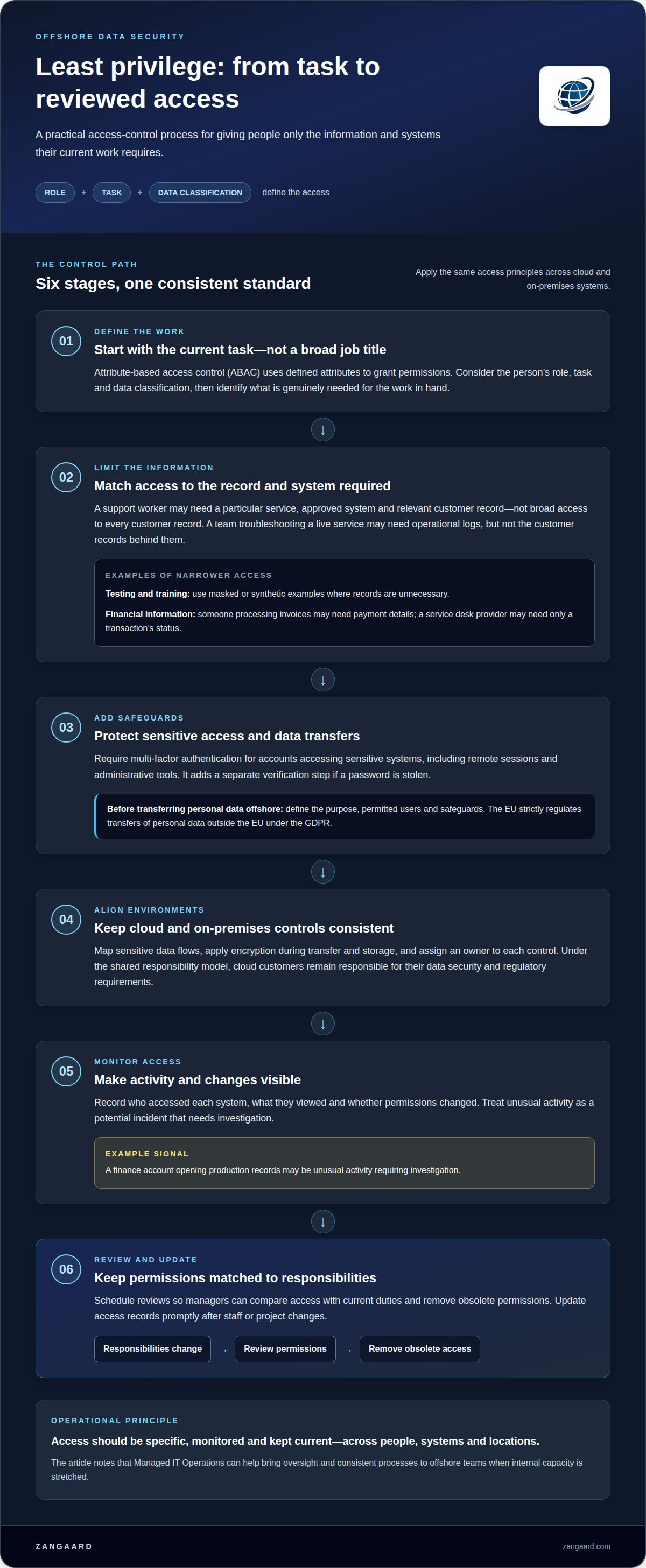
Attribute-based access control (ABAC) grants permissions according to defined attributes, rather than broad job titles alone. For example, a support worker may need access only to a particular service, approved system and relevant customer record. Combine role, task and data classification to apply least privilege: each person receives only the access needed for their current task. Clear controls reduce unnecessary exposure without obstructing routine work.
Access to production data should match the task. A team troubleshooting a live service may need operational logs, but not every customer record behind them. Where records are unnecessary, use masked or synthetic examples for testing and training. This keeps confidential information out of routine workflows while allowing teams to work efficiently. Apply the same distinction to financial information: someone processing invoices may need payment details, while a service desk provider may need only a transaction’s status.
Require multi-factor authentication for accounts that access sensitive systems, including remote sessions and administrative tools. It adds a separate verification step if a password is stolen. For distributed teams testing multi-factor pathways or isolating external messaging, tools like Proxied can help manage remote verification flows without exposing primary business numbers. Before transferring personal data to an offshore team, define the purpose, permitted users and safeguards. The European Union strictly regulates transfers of personal data outside the EU under the GDPR, so data flows and access arrangements must meet applicable requirements.
Monitoring should record who accessed each system, what they viewed and whether permissions changed. Schedule reviews so managers can compare access with current duties and remove obsolete permissions. Treat unusual activity, such as a finance account opening production records, as a potential incident that needs investigation. After a staff or project change, update access records promptly. This makes accountability visible and supports a controlled response if a breach occurs.
2. Consistent controls across cloud and on-premises systems
For Denmark and North Sea operations, the GDPR governs personal-data processing. According to the European Union, it strictly regulates transfers of personal data outside the EU. The European Union states that non-compliance can lead to fines of up to 4% of a company’s global turnover. The European Union adopted Directive 2016/1148/EU to address cybersecurity of IT networks, but it does not specifically identify upstream oil and gas infrastructure.
For offshore partners, ISO 27001 certification can help assess their information security management. Contracts should document each party’s data protection responsibilities, permitted data use, storage arrangements and breach consequences. Specify how a partner reports an incident, supports investigation and returns or deletes data when the agreement ends.
Cloud and on-premises systems need aligned security measures, not separate standards. Under the shared responsibility model, cloud customers remain responsible for their data security and regulatory requirements. A practical strategy maps sensitive data flows, applies encryption during transfer and storage, and assigns an owner to each control. Risk assessments can then help prioritise gaps and shape a cybersecurity roadmap.
For operational technology, separate business IT access from industrial control systems and restrict remote connections to approved users and purposes. NIST Special Publication 800-82 covers cybersecurity risk assessment and management for industrial control systems. Include asset inventories, controlled access and secure Remote Desktop configurations in the assessment and resulting processes.
Offshore backup and recovery plans should identify which systems and data to restore first, where protected copies are stored, and who can authorise recovery. Test restoration procedures against realistic service disruptions, then document incident roles, communication routes and recovery actions. These steps connect data protection with operational continuity, rather than treating security as policy alone.
3. Offshore data security as an operational issue
Data security in offshore operations is a shared responsibility spanning people, systems and locations. A vessel, shore-based office and global support team may handle the same sensitive data using different infrastructure. Assign operational owners, document relevant data flows and align incident procedures so each environment follows consistent policies.
The main threats include phishing, ransomware, email compromise, insider activity and data breaches. In a survey of offshore oil and gas participants, 67% identified email hacks, 56% ransomware and 55% phishing as probable threats to offshore assets. Practical measures include phishing exercises, secure remote access, malware detection and monitoring that connects unusual activity with a defined response.
Offshore cybersecurity costs depend on the scope, systems covered, monitoring needs and recovery requirements; costs are provided after a quote request. When comparing providers, consider which infrastructure is covered, who holds operational responsibilities, how incidents are handled and whether controls suit the working environment, rather than focusing on price alone.
In Denmark, incident reporting depends on the type of incident and the rules that apply to the organisation and data involved. Record when the incident was detected, which systems and data were affected, and what containment action was taken. Then follow the relevant reporting process and document notification decisions.
Make data security in offshore operations part of continuity planning by connecting monitoring to named responders, escalation routes and recovery procedures. For example, an unexpected login to a vessel’s business network should prompt an investigation of the account, access route and affected systems. Test these steps against realistic disruptions so security measures support continuity without obstructing necessary work.
ZANGAARD: Managed IT Operations
ZANGAARD provides Managed IT Operations for businesses coordinating Danish oversight with offshore teams. When access policies, infrastructure and support processes span locations, a managed operating model can clarify responsibilities. IT Infrastructure Management and a Scalable Service Desk connect infrastructure oversight with day-to-day user support, while Outsourcing Services help organisations extend operations offshore.
This approach is a practical next step when internal teams need support coordinating service delivery across cloud and on-premises environments, or when offshore growth makes ownership harder to manage. The focus is operational: define how IT responsibilities fit together and maintain consistent service processes across the organisation. Contact ZANGAARD to discuss your offshore operating model.
Make security part of the operating model
As offshore teams, systems or responsibilities change, treat data security in offshore operations as an ongoing design decision, not a control set once and left untouched. Clear ownership helps security practices keep pace with operational changes and gives leaders a sound basis for prioritising improvements.
A useful next step is to identify where security responsibilities intersect with daily IT operations, then decide where additional structure would clarify accountability. ZANGAARD can discuss how its services support that operating model without adding unnecessary complexity.
With a considered approach, your organisation can build offshore operations on a stronger foundation.
Frequently Asked Questions
What cybersecurity standards apply to offshore oil and gas operations?
Relevant standards depend on the systems and operations involved. The IMO issued Resolution MSC.428(98) on maritime cyber risk management in 2017. NIST Special Publication 800-82 covers cybersecurity risk assessment and management for industrial control systems. Use these as structured references for maritime and industrial risks, then map their guidance to the assets and obligations in scope; neither replaces a legal assessment.
What are best practices for securing offshore satellite and remote communications?
Protect satellite and remote connections with encrypted communication channels, and restrict them to approved users and business purposes. For example, a remote support session should use an authorised route and access only the systems required for the task. Keep communications with operational technology separate from general business traffic, and define an alternative contact route for reporting suspicious messages or connection failures.
How should offshore companies manage identity, access, and endpoint security?
Link each account to a named person and an approved device so investigations can establish who acted and from where. Use a joiner, mover and leaver process to create, adjust and close accounts as responsibilities change. Maintain an inventory of devices used offshore, apply consistent security settings, and investigate endpoints outside approved configurations before they connect to sensitive systems.
How can offshore operators assess third-party and supply-chain cybersecurity risks?
Start by mapping which suppliers can access systems, handle sensitive data or support critical operations. Assess the consequences if each dependency becomes unavailable or compromised, including subcontracted services and remote maintenance routes. Record ownership, access scope and incident responsibilities, then revisit the assessment when a supplier, system connection or data flow changes. This makes supply-chain oversight a maintained operational process.

Disclaimer
The purpose of this article is to generate inspiration, reflection and to start a debate across markets, industries and organizations. We do not recommend any actions soly based on the article statements, claims or opinions, but recommend you to reach out directly to ZANGAARD for a qualified review, dialogue and/or consultation. Reach out at [email protected] or visit our website www.zangaard.com


