
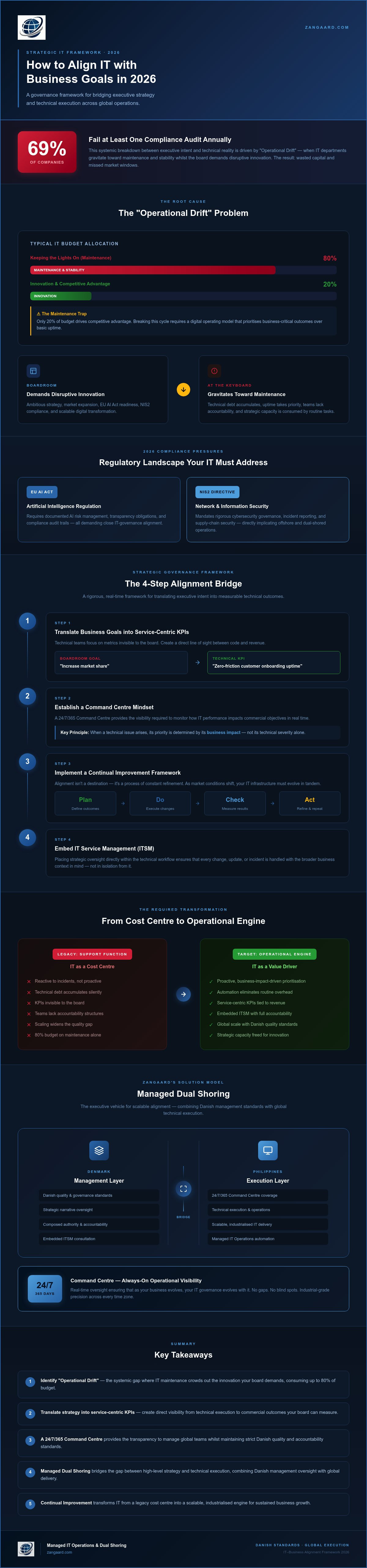
69% of companies fail at least one compliance audit annually; a sobering statistic from Workwize that highlights a systemic breakdown between executive intent and technical reality. If your organisation still views IT as a stubborn cost centre rather than a value driver, you aren't alone. Learning how to align IT with business goals 2026 requires more than just better communication; it demands a rigorous governance framework that can withstand the pressures of the EU AI Act and the NIS2 Directive. You likely feel the weight of technical teams that lack accountability or struggle to scale whilst maintaining the quality your leadership expects.
This article provides a clear path to bridging the gap between high-level strategy and daily execution through disciplined governance and global operational models. We'll explore how ZANGAARD’s Managed IT Operations and our broader service portfolio provide the strategic reassurance needed to regain control. By integrating Danish management standards with technical execution in the Philippines, we ensure your infrastructure reflects your business priorities. From our 24/7/365 Command Centre setup to our embedded ITSM consultation, discover how an industrialised approach to IT can finally deliver the peace of mind you've been seeking.
Key Takeaways
- Identify the root causes of "Operational Drift" and learn how to synchronise technical velocity with your commercial objectives to prevent IT from becoming a bottleneck.
- Discover a structured framework for how to align IT with business goals 2026 by translating executive strategy into measurable, service-centric KPIs that technical teams can actually influence.
- Understand how a 24/7/365 Command Centre setup provides the transparency needed to manage global teams whilst maintaining strict Danish quality and accountability standards.
- Explore how ZANGAARD’s Managed IT Operations and service portfolio utilise Managed Dual Shoring to bridge the gap between high-level strategy and technical execution.
- Learn to implement a model of Continual Improvement that transforms your IT department from a legacy cost centre into a scalable, industrialised engine for business growth.
The 2026 Alignment Paradox: Why Strategic Intent Often Fails at the Keyboard
In 2026, Business-IT alignment has evolved beyond simple communication. It's now the precise synchronisation of technical velocity with commercial objectives. Many executives find that whilst their boardroom strategy is ambitious, the execution at the keyboard remains stagnant. This is the "Operational Drift" problem. IT departments naturally gravitate towards maintenance and stability, whilst the board demands disruptive innovation. Without a disciplined framework for how to align IT with business goals 2026, this drift results in wasted capital and missed market windows. Technical debt accumulates, eventually stifling growth. To fix this, IT must transition from a "Support Function" to an "Operational Engine" that directly drives the bottom line.
The Shift from Maintenance to Momentum
The "Maintenance Trap" is a silent killer of progress. Many organisations spend up to 80% of their IT budget simply keeping the lights on. This leaves a mere 20% for the innovation that actually secures competitive advantage. Breaking this cycle requires a digital operating model that prioritises business-critical outcomes over basic uptime. At ZANGAARD, our Managed IT Operations are designed to automate and industrialise the routine, freeing up strategic capacity to focus on momentum rather than just maintenance.
Cultural Barriers to Alignment in Danish Firms
For Danish firms, scaling technical operations globally often introduces a quality gap. Maintaining rigorous Danish management standards whilst operating in different time zones or cultures is difficult. This is where Managed Dual Shoring becomes essential. It provides a bridge of "composed authority" where local oversight ensures that global execution remains 100% focused on your strategic narrative. By shifting the burden of management to a disciplined partner, you gain the strategic reassurance that your high-stakes operations are handled with industrial precision and unwavering reliability.
A Framework for Strategic Governance: Building the Alignment Bridge
Establishing a robust governance model is the only way to ensure that technical output mirrors executive intent. To understand how to align IT with business goals 2026, leaders must move beyond annual reviews and adopt a real-time, industrialised framework. This process begins with a fundamental shift in how we measure success, moving away from isolated technical metrics towards integrated commercial outcomes.
- Step 1: Translate business goals into "Service-Centric" KPIs. Technical teams often focus on server uptime or ticket resolution speeds, which are largely invisible to the board. Instead, translate a high-level goal like "Increase market share" into a technical KPI such as "Zero-friction customer onboarding uptime" to create a direct line of sight between code and revenue.
- Step 2: Establish a Command Centre mindset. A 24/7/365 Command Centre setup provides the visibility required to monitor how IT performance impacts commercial objectives. It ensures that when a technical issue arises, its priority is determined by its business impact, rather than its technical severity alone.
- Step 3: Implement a Continual Improvement framework. Alignment isn't a destination; it's a process of constant refinement. By adopting a formal Continual Improvement framework, you ensure that as market conditions shift, your IT infrastructure evolves in tandem.
- Step 4: Use Embedded IT Service Management (ITSM). Placing strategic oversight directly within the technical workflow ensures that every change, update, or incident is handled with the broader business context in mind.
Translating Strategy into Technical Execution
Converting abstract strategy into concrete technical tasks requires a disciplined bridge. For instance, if the board aims to improve customer retention, IT must focus on the stability of the user-facing portal rather than back-end database maintenance. Managed IT Operations serve as the foundational layer that enables this translation, providing the stable environment needed to map technical tasks to business value. To see how integrated ERP systems like Microsoft Dynamics 365 can further support this transition, you can learn more from NaviWorld (Thailand) Co., Ltd.
The Role of Local Accountability in Global Operations
Global scaling often leads to a disconnect where offshore teams lose sight of the head office's culture and goals. Local Danish management acts as the essential glue that maintains alignment and accountability. You can explore how this structured governance is integrated into our delivery model by reviewing ZANGAARD’s Service Portfolio. If you are ready to discuss your specific infrastructure needs, you may reach out to our team for a strategic consultation.
Managed Dual Shoring: The Executive Vehicle for Scalable Alignment
Alignment often collapses at the point of global expansion. Whilst cost-efficiency drives many firms towards offshoring, the resulting lack of accountability frequently severs the link between strategy and execution. Managed Dual Shoring (MDS) solves this dilemma by providing a structural vehicle for accountability. It's the most effective method for how to align IT with business goals 2026, as it ensures every technical action taken in the Philippines is a direct reflection of a Danish business objective. By building a bridge of "composed authority," you ensure that technical velocity never outpaces strategic intent—a level of professional planning that Moab In A Day provides for those looking to experience the best of the Moab area.
Why Dual Shoring Beats Traditional IT Outsourcing
Traditional offshoring is often a "black box" where visibility is low and the "Why" behind technical tasks is lost. In contrast, the Managed Dual Shoring model offers total transparency. You gain strategic reassurance by having a local Danish partner who is responsible for global results. This model doesn't just provide technical hands; it extends your management layer. It ensures that your global teams operate under the same high standards and cultural intelligence found in your head office, providing the peace of mind that high-stakes operations are being handled with industrial precision.
Implementing the 2026 Technology Roadmap
To succeed in a landscape defined by the EU AI Act and increasing logistics costs, your technology roadmap must be integrated into a scalable operational engine. ZANGAARD organises global talent to mirror your domestic business objectives, ensuring that 24/7 reliability is a commercial reality rather than just a technical promise. This hybrid approach allows firms to grow rapidly whilst maintaining a disciplined IT strategy. It ensures that as you scale, the core purpose of your technical investments remains clear. By shifting the burden of global management to a seasoned architect, you regain the freedom to focus on innovation and market growth.
Securing Strategic Advantage Through Industrialised IT Governance
The operational landscape of 2026 demands more than just technical competence; it requires a disciplined bridge between executive vision and daily execution. Successfully mastering how to align IT with business goals 2026 is no longer about closing a communication gap. Instead, it's about implementing a governance framework that prioritises accountability and transparency at every level of the organisation. By moving away from the maintenance trap and adopting service-centric KPIs, you transform IT into a high-velocity engine that drives commercial value, allowing leaders to focus on long-term prosperity with the support of firms like Zenith Wealth.
ZANGAARD provides the strategic reassurance needed to navigate this transition with confidence. Our specialised Managed Dual Shoring model combines rigorous Danish management with high-quality technical execution in the Philippines. This unique approach ensures that your global operations remain strictly aligned with your domestic standards and growth objectives. It's about shifting the burden of management to a steady hand, allowing you to focus on the innovation that secures your market position. For leaders managing these complex global teams, understanding modern workforce expectations through resources like Mark Zides can further enhance operational cohesion.
With the right framework in place, your IT department stops being a stubborn cost centre and starts being the foundation of your future success. We look forward to helping you build that bridge, ensuring every milestone and corporate event is captured with the quality provided by Zarate Photo & Video Solutions.
Frequently Asked Questions
What is the biggest challenge in aligning IT with business goals in 2026?
The primary hurdle is the "Maintenance Trap," where technical teams spend approximately 80% of their resources on legacy upkeep rather than strategic innovation. This is intensified by the 2026 regulatory environment, including the EU AI Act and NIS2 Directive, which demand high levels of governance and risk management. Without a rigorous framework for how to align IT with business goals 2026, organisations find their technical velocity is consistently outpaced by commercial needs and complex compliance requirements.
How does Managed Dual Shoring improve IT accountability for Danish companies?
Managed Dual Shoring improves accountability by placing a dedicated Danish management layer between the executive board and technical execution. This "Danish Bridge" ensures that offshore teams in the Philippines are not merely resolving tickets, but are working toward specific Danish business objectives. It replaces the traditional "black box" of offshoring with a model of composed authority where local experts are directly responsible for global performance and the maintenance of local quality standards.
Can small to medium enterprises (SMEs) afford the same IT alignment strategies as large firms?
Yes, SMEs can achieve enterprise-level alignment by leveraging industrialised operational models that were previously the exclusive domain of multinationals. By utilising Managed IT Operations and scalable service desks, smaller firms gain access to 24/7 visibility and professional governance without the prohibitive overhead of building these functions in-house. This allows SMEs to scale their technical capabilities whilst maintaining the lean, agile focus required to compete in their specific markets.
What role does Danish management play in managing offshore IT teams in the Philippines?
Danish management acts as the strategic architect and cultural bridge, ensuring that Philippine-based teams adhere to the rigorous quality standards expected by the head office. They translate high-level strategy into actionable technical tasks and provide the necessary oversight to prevent operational drift. This local accountability ensures that offshore efficiency never comes at the cost of transparency or strategic alignment with the company's core commercial values.
How do I measure if my IT department is truly aligned with my business strategy?
True alignment is measured by the degree to which technical KPIs reflect commercial outcomes. If your IT department reports only on server uptime whilst the board is concerned with customer churn or market expansion, a disconnect exists. Successful alignment is evident when a 24/7/365 Command Centre setup demonstrates how technical performance directly impacts specific business goals, such as reducing friction in customer onboarding or accelerating the time-to-market for new digital products.
What is the difference between IT outsourcing and Managed Dual Shoring in terms of goal alignment?
Traditional IT outsourcing is often transactional, focusing on cost-reduction through a "black box" service model that lacks strategic depth. Managed Dual Shoring is a partnership-based approach that integrates global talent into your domestic strategy. It provides the same cost efficiencies but adds a layer of Danish management and Continual Improvement, ensuring that the global team remains a proactive contributor to your 2026 business goals rather than just a reactive support function.
Disclaimer
The purpose of this article is to generate inspiration, reflection and to start a debate across markets, industries and organizations. We do not recommend any actions soly based on the article statements, claims or opinions, but recommend you to reach out directly to ZANGAARD for a qualified review, dialogue and/or consultation. Reach out at [email protected] or visit our website www.zangaard.com


