

What if the geographical proximity of your IT team isn't the primary driver of operational success? Many executive leaders find that whilst moving talent closer to home reduces time-zone friction, it often fails to resolve the underlying "management tax" that comes with overseeing distant teams. You've likely felt the weight of maintaining quality across borders or the persistent worry that accountability is lost in translation. Understanding the strategic nuances of nearshoring vs dual shoring is essential for any organisation looking to scale whilst retaining absolute control over its digital assets.
This article provides a clear comparison of these models to help you determine which approach offers the best balance of cost-efficiency and operational reliability. Through our ZANGAARD Services and strategic service portfolio, we highlight how Managed IT Operations can bridge the gap between high-level governance and daily execution. We will examine how local leadership combined with offshore delivery reduces risk and ensures your IT Infrastructure Management remains resilient, disciplined, and fully aligned with your broader commercial objectives.
Key Takeaways
- Distinguish between nearshoring's geographical proximity and dual shoring's hybrid management structure to identify the most effective model for your IT Infrastructure Management.
- Evaluate the strategic trade-offs of nearshoring vs dual shoring to determine how to leverage offshore price points whilst maintaining local accountability and control.
- Learn how to eliminate the "management tax" of overseeing distant teams by integrating local leadership that provides direct oversight and operational transparency.
- Explore how ZANGAARD’s Managed IT Operations and diverse service portfolio deliver scalable support and 24/7 Service Desk availability.
- Understand the roadmap for transitioning to a dual-shore model that reduces operational risk and ensures consistent quality across your global IT strategy.
Defining the Landscape: What is Nearshoring and Dual Shoring?
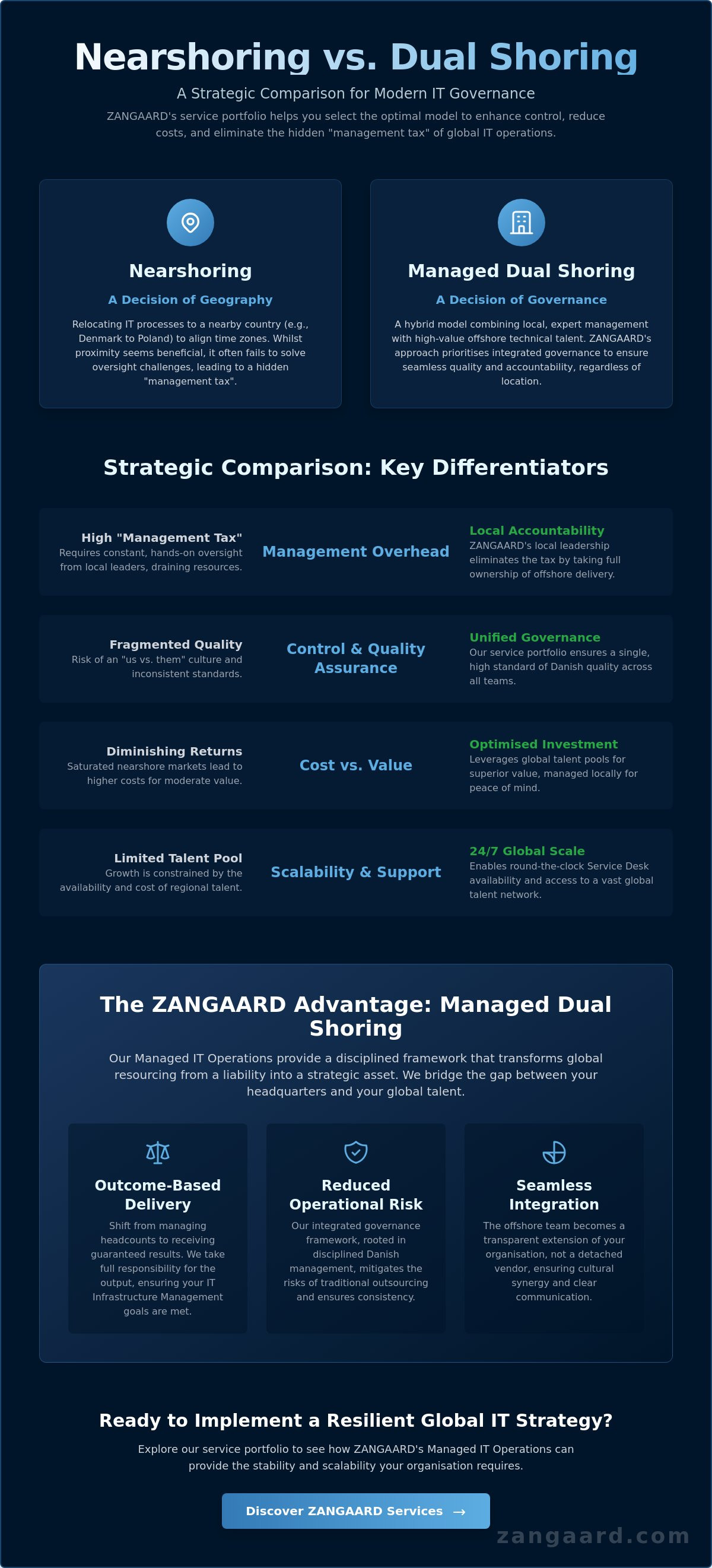
The choice between nearshoring vs dual shoring often dictates the long-term stability of a global IT strategy. Nearshoring involves relocating IT processes to a nearby country, such as a Danish firm partnering with a team in Poland, primarily to align time zones and cultural behaviours. Dual shoring is a more sophisticated evolution. It is a hybrid architecture that maintains local management and oversight whilst leveraging technical talent from offshore locations. The core distinction is clear. Nearshoring is a geographic decision; dual shoring is a governance decision.
The Mechanics of Nearshoring
Regional proximity offers tangible benefits. Travel is simpler. Cultural blocks often share similar work ethics. Yet, many organisations discover the "proximity trap" too late. They assume that being only two hours away removes the need for rigorous oversight. It doesn't. You can review the foundational principles of What is Nearshoring? to understand its rise, but the model often leaves a heavy management tax on local leaders who must still micromanage distant outputs.
The Managed Dual Shoring Innovation
Dual shoring creates a disciplined bridge between local leadership and global execution. Whilst nearshoring focuses on geography, dual shoring prioritises integrated governance. Through our Managed IT Operations, ZANGAARD provides the local accountability required to secure offshore delivery. This ensures your IT Infrastructure Management remains transparent and high-performing. In 2026, businesses are favouring this model because it balances the high-value/low-cost ratio of offshore teams with the peace of mind provided by local experts. It turns a distant resource into a seamless, controlled extension of your own office.
Nearshoring vs Dual Shoring: A Strategic Comparison
The debate of nearshoring vs dual shoring often centres on cost, yet the real differentiator is the depth of operational control. Nearshoring typically carries a premium for labour because of its proximity to Western Europe. However, as nearshore markets in regions like Eastern Europe become increasingly saturated, the cost-to-value ratio begins to diminish. Dual shoring circumvents this by leveraging vast talent pools in locations like the Philippines whilst maintaining a local management layer. This approach mirrors the strategic advantages of dual sourcing, where redundancy and competitive pressure ensure higher quality and lower risk.
Cultural Synergy and Communication
Physical distance is often a red herring in global IT. Shared management values, such as the disciplined Danish approach to transparency and accountability, matter far more than being in the same time zone. Traditional nearshoring models frequently suffer from an "us vs them" mentality where the remote team feels like a detached vendor. By contrast, a dual-shore architecture integrates the offshore team into a unified governance framework. This ensures that every developer or engineer, regardless of their coordinates, operates under the same cultural and professional standards.
Governance and Quality Assurance
Transitioning to managed IT operations allows a business to shift from "body shopping" to "outcome-based" delivery. This model prioritises the final result over mere headcount. Local oversight ensures that offshore technical execution meets domestic standards. When you partner with experts through our Managed IT Operations, you gain a partner who takes full responsibility for the output. You might find that reviewing our service portfolio reveals how this local-to-global bridge provides the scalability your organisation requires without sacrificing the precision of Danish leadership. It's about regaining peace of mind through a structured, industrialised process that mitigates the risks of traditional outsourcing.
Implementing Managed Dual Shoring for Long-term Stability
Transitioning to a managed dual-shore environment requires a disciplined shift from fragmented oversight to a unified governance framework. Whilst Dual-shoring supply chains are often discussed in manufacturing contexts, the model is equally transformative for IT. It allows firms to move away from the limitations of in-house or nearshore setups that often lack the necessary 24/7 Service Desk availability. By integrating Danish management standards with high-calibre technical teams in the Philippines, organisations achieve a level of efficiency that single-location models cannot match. Our Managed IT Operations provide the rigorous structure needed to make this transition seamless and risk-averse.
The ZANGAARD Advantage: Local Leadership, Global Talent
We've mastered the synergy between domestic oversight and international scalability. By placing Danish leaders at the helm of operations, we ensure that technical execution in the Philippines aligns perfectly with your internal culture and quality benchmarks. We organise our teams to prioritise transparency and reliability, which builds the peace of mind necessary for high-stakes digital environments. This isn't just about resource allocation. It's about creating a model where the burden of daily management is handled by experts who understand both your local expectations and the complexities of global delivery. In the debate of nearshoring vs dual shoring, this local-to-global bridge is what ensures your favourite-status reliability remains intact as you scale.
Next Steps for Strategic IT Growth
Evaluating your current infrastructure is the first step toward long-term stability. A thorough assessment identifies where a dual-shore model can reduce costs whilst improving response times. We invite you to consult with us to build a bespoke service portfolio that aligns with your specific enterprise goals. This strategic alignment ensures your IT operation is not just a support function, but a scalable asset that drives growth. Regaining control over your global strategy starts with a partner who values thoroughness over haste and accountability over simple proximity.
Securing Your Global Operational Future
The choice of nearshoring vs dual shoring defines whether your IT strategy is merely a cost-saving exercise or a driver of long-term stability. Whilst proximity has its merits, only a dual-shore model effectively bridges the gap between offshore efficiency and local accountability. By integrating Danish management with scalable technical operations in the Philippines, you ensure that every process remains transparent and every outcome meets your rigorous domestic standards.
ZANGAARD provides the composed authority needed to govern complex global operations through our ZANGAARD Services. We take the management burden off your shoulders, delivering 24/7 Service Desk availability and resilient IT Infrastructure Management. We encourage you to Explore ZANGAARD's Managed Dual Shoring Services and review our service portfolio to find the right fit for your enterprise goals. Take the next step toward a disciplined, high-performing IT architecture that supports your growth with unwavering reliability.
Frequently Asked Questions
What is the main difference between nearshoring and dual shoring for IT?
The fundamental difference lies in the governance structure rather than just physical proximity. Nearshoring focuses on relocating processes to a nearby country to align time zones. Dual shoring is a hybrid architecture that integrates local Danish leadership with offshore technical execution. When comparing nearshoring vs dual shoring, the distinction is clear: one is geographic, the other is governance-based. Our Managed IT Operations exemplify this by providing a disciplined bridge between strategy and delivery.
Is dual shoring more expensive than traditional nearshoring?
Dual shoring is often more cost-effective because it eliminates the hidden "management tax" of overseeing nearshore teams without local experts. Whilst nearshore labour costs are rising in saturated European markets, dual shoring leverages high-value talent in regions like the Philippines. When evaluating nearshoring vs dual shoring, the latter provides a superior risk-adjusted return by combining offshore price points with domestic quality control. You can see how we structure these efficiencies in our service portfolio.
How does dual shoring improve IT service quality?
Quality is improved through direct local accountability and a move toward outcome-based delivery. In a dual-shore model, local managers ensure that every technical task meets your specific domestic standards and cultural expectations. This removes the "us vs them" friction common in traditional outsourcing. By using a structured, industrialised process, we ensure that your IT Infrastructure Management remains consistent, transparent, and aligned with your broader commercial objectives.
Can dual shoring support a 24/7 service desk model?
Dual shoring is the ideal framework for a robust 24/7 Service Desk. By spreading operations across different time zones whilst maintaining a central management hub, we provide continuous support without the premium costs of local night shifts. This globalised reach ensures that your infrastructure is monitored and supported around the clock. It provides the peace of mind that comes from knowing expert assistance is always available, regardless of the hour or location.
Disclaimer
The purpose of this article is to generate inspiration, reflection and to start a debate across markets, industries and organizations. We do not recommend any actions soly based on the article statements, claims or opinions, but recommend you to reach out directly to ZANGAARD for a qualified review, dialogue and/or consultation. Reach out at [email protected] or visit our website www.zangaard.com


