

If your global IT operations were audited tomorrow, would your confidence rest on a paper certificate or on the disciplined reality of your daily execution? For many Danish organisations, the shift toward offshore models often introduces a lingering fear that data security and accountability have become diluted across borders. It's a common anxiety that a standard vendor security assessment for IT outsourcing might tick a box without actually mitigating the operational risks that keep board-level stakeholders awake at night.
At ZANGAARD, we treat security as a rigorous governance discipline rather than a static checklist. By examining our managed IT services portfolio, you'll see how we embed ISO 27001:2022 standards into the heart of global technical execution. This article provides a framework to integrate these standards into your operations, ensuring local Danish accountability whilst maintaining a scalable, secure-by-design infrastructure. Discover how to move beyond documentation complexity to achieve genuine peace of mind.
Key Takeaways
- Understand why ISO 27001:2022 serves as a strategic governance framework for Danish organisations seeking to scale their global IT footprint securely.
- Discover how integrating technical controls within a 24/7/365 Command Centre ensures your security policies are operationalised rather than merely documented.
- Learn to bridge the accountability gap in offshore models by combining Philippine technical expertise with disciplined Danish management and oversight.
- Simplify every vendor security assessment for IT outsourcing by exploring how ZANGAARD’s service portfolio delivers transparent, audit-ready compliance across all borders.
The Fundamentals of ISO 27001 Compliant IT Services: Building a Robust ISMS
ISO/IEC 27001:2022 represents the global gold standard for establishing a rigorous Information Security Management System (ISMS). For Danish organisations expanding their reach in 2026, this framework is no longer a luxury; it's a strategic necessity for maintaining brand reputation. As the regulatory landscape becomes increasingly fragmented, a robust ISMS provides the "industrialised" precision needed to scale without losing control. It shifts the focus from reactive firefighting to a proactive, risk-based governance model that ensures every technical action aligns with high-level business objectives.
This disciplined approach serves as a vital component of a modern vendor security assessment for IT outsourcing. It creates a unified language between local Danish leadership and global technical teams. When you integrate ZANGAARD’s managed IT operations into your business, you're adopting a bridge-building architecture. We connect high-level security strategy with daily execution in the Philippines, ensuring that technical rigour never comes at the cost of transparency or Danish accountability. Explore how these standards are applied across our IT services portfolio to provide the peace of mind your board demands.
The Three Pillars of Information Security: Confidentiality, Integrity, and Availability
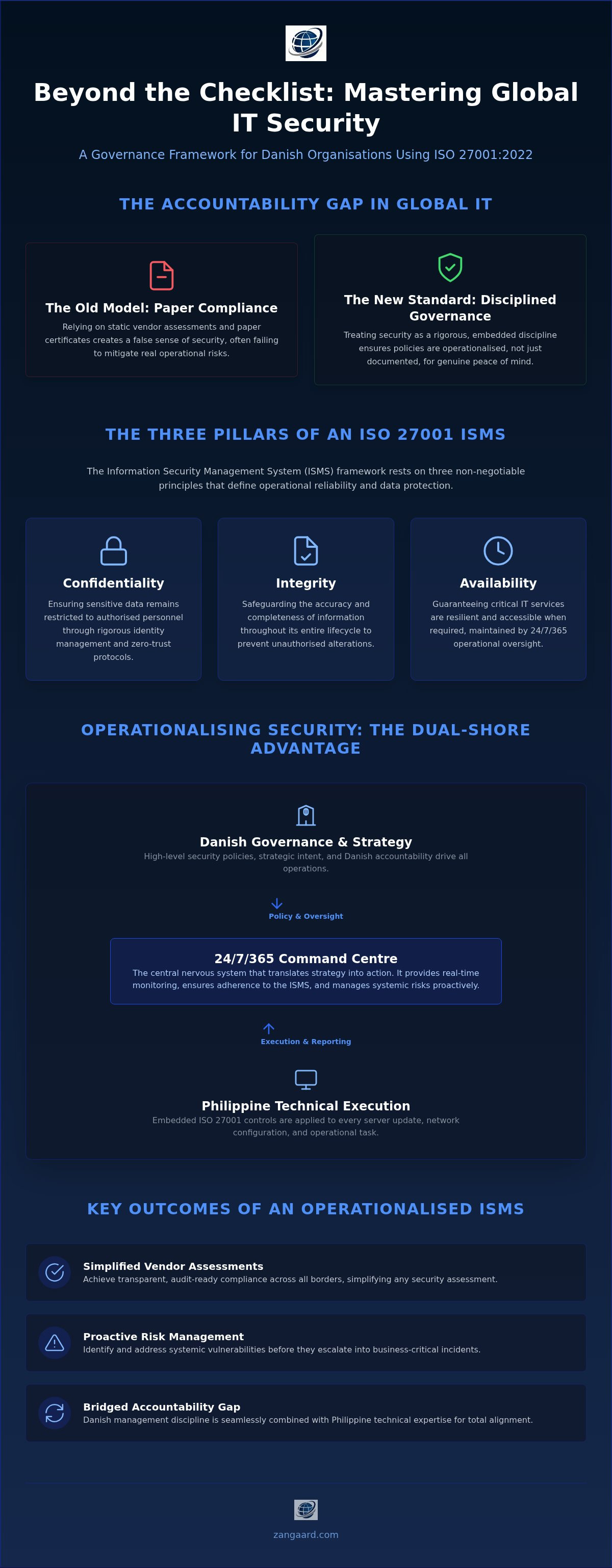
The ISMS framework rests on three non-negotiable principles that define operational reliability. These pillars ensure that security isn't just a static certificate but a living part of your infrastructure. Our methodology transforms these concepts into reality.
- Confidentiality: We ensure sensitive data remains restricted to authorised personnel through rigorous identity management and zero-trust protocols.
- Integrity: Our processes safeguard the accuracy and completeness of information throughout its entire lifecycle to prevent unauthorised alterations.
- Availability: We guarantee that critical IT services are resilient and accessible exactly when the business requires them, maintained by our 24/7/365 oversight.
Operationalising Security: How Managed IT Services Maintain ISO 27001 Standards
Security isn't a static achievement; it's a living operational behaviour. Integrating ISO 27001 controls into daily IT infrastructure management services transforms theoretical policies into industrialised reality. When conducting a vendor security assessment for IT outsourcing, stakeholders must look beyond the certificate to see how documentation aligns with actual technical execution. At ZANGAARD, we ensure our processes aren't just filed away for audits. They're embedded in every server update and network configuration.
Our 24/7/365 Command Centre acts as the central nervous system for this compliant framework. It monitors security events in real time, ensuring operational resilience whilst maintaining strict adherence to your ISMS. By leveraging our bespoke Problem Management SaaS applications, we identify systemic vulnerabilities before they can escalate into business-critical incidents. This methodical approach provides the transparency required to maintain trust across global borders, ensuring technical execution in the Philippines mirrors Danish strategic intent.
Continual Improvement and Risk Management in Daily Execution
A robust security posture demands more than an annual audit. It requires the constant vigilance of a 24/7 IT service desk that prioritises continual improvement cycles. This ongoing rigour simplifies any subsequent vendor security assessment for IT outsourcing by providing a continuous audit trail. Our embedded IT Service Management consultation helps you adapt to a shifting threat landscape, using automated reporting to turn complex technical data into strategic insights for the board. If you're ready to move beyond basic compliance, reach out to our team to discuss a more disciplined architecture.
The Dual-Shore Advantage: Danish Governance for Compliant Global IT Operations
Traditional offshoring models often struggle to bridge the distance between high-level Danish security standards and daily technical execution. This accountability gap is frequently the primary point of failure during a vendor security assessment for IT outsourcing. Organisations find that whilst technical skills are available, the disciplined governance required for ISO 27001 compliance is often lost in translation across borders. ZANGAARD addresses this risk through Managed Dual Shoring, a model that maintains strict Danish oversight over every operational detail.
By combining technical expertise in the Philippines with local Danish management, we ensure that security controls remain consistent regardless of geography. This hybrid approach provides the scalability of IT outsourcing in the Philippines without sacrificing the transparency or reliability expected by Nordic board-level stakeholders. It's a strategic architecture designed to provide peace of mind through unwavering accountability and industrialised precision.
Bridging the Accountability Gap in Offshore IT Services
Effective compliance requires more than technical ability; it demands a cultural alignment with Danish standards of precision. Our Danish leadership acts as the essential bridge, translating complex regulatory requirements into actionable tasks for our global teams. This synergy allows for secure enterprise growth in 2026, where efficiency doesn't compromise integrity. If you're concerned about how your current model stands up to a vendor security assessment for IT outsourcing, we invite you to discuss your specific security requirements with our consultants.
Securing Your Global Operational Future
Transitioning to a global delivery model doesn't mean compromising on the integrity of your ISMS. By integrating technical rigour with disciplined Danish oversight, organisations achieve a scalable infrastructure that's secure by design. A thorough vendor security assessment for IT outsourcing becomes significantly more straightforward when your provider prioritises transparency and continual improvement. Our specialised service portfolio and 24/7/365 Command Centre ensure that your operations are monitored with industrialised precision. This model provides the peace of mind required for board-level stakeholders whilst delivering the efficiency of global execution. You've seen how a dual-shore architecture bridges the accountability gap; now it's time to operationalise that strategy for your own organisation.
Take the next step in building a resilient, compliant infrastructure that supports your long-term growth objectives with confidence.
Frequently Asked Questions
What is the difference between ISO 27001 compliance and certification?
Compliance refers to the internal adherence to the ISO/IEC 27001:2022 standards, where an organisation actively implements the necessary security controls. Certification is the formal validation by an accredited third party that your Information Security Management System (ISMS) meets every requirement. Whilst compliance builds the operational foundation, certification provides the documented proof of rigour essential for any vendor security assessment for IT outsourcing.
Can an offshore IT team truly be ISO 27001 compliant?
Offshore teams can achieve full compliance if they operate within a disciplined governance framework that mirrors Danish standards of accountability. The primary challenge is typically the accountability gap rather than geography. By implementing industrialised processes and local oversight, global technical teams in the Philippines can execute security controls with the same precision as a domestic team, ensuring a seamless and secure operational environment.
How does Managed Dual Shoring improve our security posture?
Managed Dual Shoring improves security by combining technical execution in the Philippines with local Danish management and accountability. This hybrid model ensures that high-level security strategies are translated into daily operational behaviours without loss of control. It provides the transparency needed for a successful vendor security assessment for IT outsourcing, as Danish leaders maintain direct oversight of the technical controls and compliance documentation.
What are the mandatory documents required for ISO 27001?
ISO 27001:2022 requires several core documents to maintain a robust ISMS, including the scope definition, the Information Security Policy, and the Statement of Applicability. Organisations must also document their risk assessment and treatment methodologies alongside evidence of internal audits. These records provide the industrialised precision required to demonstrate that your security controls are actively managed rather than simply existing as static policies.
Disclaimer
The purpose of this article is to generate inspiration, reflection and to start a debate across markets, industries and organizations. We do not recommend any actions soly based on the article statements, claims or opinions, but recommend you to reach out directly to ZANGAARD for a qualified review, dialogue and/or consultation. Reach out at [email protected] or visit our website www.zangaard.com


